

Leg Lengthening (Aesthetic and Medical) | Medical Time
The procedure of lengthening the lower extremities is performed for two main reasons: for cosmetic (aesthetic) purposes to increase height, or for medical reasons due to diseases and asymmetries.

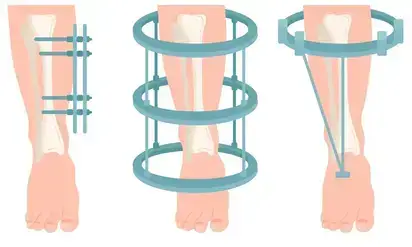
An opportunity to lengthen legs is a great achievement in medicine, which became possible thanks to the Ilizarov apparatus invention in 1952.

At Medical Time Hospital, our expert team employs these methods with more than 30 years of experience, providing safe and effective solutions for patients.

Modern orthopedic techniques allow patients not only to reach their desired height but also to completely correct accompanying leg axis deformities.

Our goal is to restore the ideal walking biomechanics, body symmetry, and improve the quality of life for every patient.

Main reasons for leg lengthening surgery

Aesthetic height increase for patients dissatisfied with their natural stature.

  • Congenital bone growth disorders, such as achondroplasia (dwarfism).
  • Correction of asymmetry (leg length difference greater than 2 cm) that hinders normal walking and leads to scoliosis.
  • Acquired shortening due to bone fractures that healed poorly.
  • Consequences of growth plate injuries during childhood, which stop the growth of one leg.
  • Specific requirements of certain professions (athletes, models, security agency workers).

Cosmetic vs. Medical indications

When lengthening the thigh bone (femur) or shin bone (tibia) for cosmetic purposes, the desired result is usually between 5 and 8 cm. Optimal and safest lengthening is 5-7 cm.

In medical conditions like achondroplasia (where adult height is 120-150 cm), a maximum lengthening of 10 to 20 cm is recommended.

Leg length difference is one of the most widespread orthopedic problems. First manifestations of congenital shortening are asymptomatic, but can lead to scoliosis formation.

In children with asymmetry, medical monitoring for 6 to 12 months is necessary to decide whether and when to operate.

Acquired leg shortening in adults due to trauma must be compensated as soon as possible, as they typically combine with posttraumatic deformities.

Important note for parents: There is a misapprehension that surgeries should always wait until the age of 16-18. In cases of significant shortening (more than 3 cm), a child should undergo surgery at the age of 6-7 to not be handicapped.

What principle is leg lengthening based on?

Regardless of the specified method, the general principle is based on Ilizarov's invention: 'The general biological property of tissue is to have growth and regeneration response to extension'.

The procedure begins with an osteotomy (precise cutting of the bone).

Then, stretching the limb step by step out with the help of the apparatus (exactly 1 mm per day) allows muscles, vessels, nerves, and skin cover to stretch progressively without losing properties.

The distance of the stretched limb is refilled with repaired, newly built bone tissue in the zone of osteotomy bone fragments.

No foreign inserts or plastics are used! The bone is lengthened by means of newly built bone tissue, which gradually transforms into fully functioning bone not different from usual bone by its strength.

What methods of lengthening do we use?

We use two main methods, depending on the patient's needs and indications: The Classic Ilizarov method and the modern Express method.

The Classic Ilizarov method is the most available and safest approach. The advantage is a minor injury rate and insignificant complications. It lets not only lengthen, but correct deformities.

However, the disadvantage of the classic method is that the patient needs several months of rigid fixation with the external apparatus on the leg until the bone unites.

That is why we use the Express method (Ilizarov + intramedullary fixation). We lengthen with the apparatus for 1.5-3 months, then remove the apparatus and fix the limb with an internal (intramedullary) nail.

Advantages of the Express method (Intramedullary nail)

Drastically reduced time of wearing the external (Ilizarov) apparatus.

  • Provides the shortest possible rehabilitation period.
  • Nail fixation (internal) guarantees rigid and complete stability.
  • The nail itself is inside the bone and has no signs of disturbance unlike the apparatus.
  • Allows physical activity in the recent days after the operation to change fixation.
  • The patient can start walking in 2 to 4 weeks without any special means of support.

Frequently asked questions about leg lengthening

Organism resources are limited. The taller the initial man's height (respectively his shin and femur length), the more size it can be lengthened. The optimal and safest lengthening for aesthetic purposes is 5-7 cm.
No. Some think that limb lengthening is a result of some 'insertion' into the bone, but it is not true. The bone is lengthened by means of newly built bone tissue, which is formed while stretching and gradually transforms into fully functioning bone.
With the classic method, the Ilizarov apparatus stays on the leg until the bone completely unites (which can take many months). With the express method, the apparatus is worn much shorter (1.5 to 3 months) only while stretching, and then it is replaced by an internal nail, drastically speeding up recovery.
There is a misapprehension that surgeries should wait until the age of 16-18. In cases of significant shortening (more than 3 cm), a child should undergo surgery at the age of 6-7 to not be handicapped due to secondary spinal problems.
The golden standard of the Ilizarov method involves stretching the bone at a rate of exactly 1 millimeter per day. This allows muscles, skin, blood vessels, and nerves enough time to adapt to the new length without damage.

Book a consultation

Get in touch and we will create a plan tailored to your needs.