Back to blog
Dijagnostika

Preventive Colonoscopy Exam | Medical Time

Discover why preventive colonoscopy is the gold standard for early polyp detection and colon cancer prevention. Painless examination with short-term anesthesia at Medical Time hospital.

14. јун 2026.
1.4k views
0 likes
Colonoscopy - an examination that preserves health

Colonoscopy - an examination that preserves health

Colon cancer is one of the most common malignant tumors today, but at the same time, it is also one of the most preventable if detected in time.

Preventive colonoscopy is the gold standard in medicine for early detection and prevention of colon diseases. With this examination, the gastroenterologist directly visualizes the mucous membrane of the entire intestine.

What makes this examination unique is the ability to diagnose precancerous changes (polyps) and safely remove them in the same act, before they even have a chance to turn into cancer.

Thanks to the progress of modern medicine, at Medical Time Hospital this examination is routinely performed under short-term intravenous anesthesia (sedation), making it an absolutely comfortable and painless experience.

Experts around the world urge that all citizens, regardless of whether they have symptoms or not, perform the first preventive colonoscopy at the latest at the age of fifty.

When is it mandatory to schedule a colonoscopy?

1

For everyone after the age of 50, as a regular and indispensable preventive screening.

2

People whose close relatives (parents, brothers, sisters) suffered from colon cancer or polyps.

3

If you notice the appearance of fresh blood in the stool, black stool or bleeding of unknown origin.

4

If you have sudden changes in the rhythm of emptying, frequent diarrhea alternating with persistent constipation.

5

When unexplained abdominal pain, chronic bloating and sudden, unintentional weight loss occur.

6

In case of poor blood counts, especially in the case of unexplained drop in iron levels and anemia.

Polypectomy: Stopping the disease in its infancy

Polypectomy: Stopping the disease in its infancy

Polyps are benign growths on the lining of the colon that cause absolutely no symptoms in their early stages. This is why most people feel completely healthy, unaware of their existence.

The problem arises because certain types of polyps (adenomas), over time and without appropriate treatment, have the biological potential to undergo malignant alteration, that is, to turn into cancer.

When our gastroenterologist notices such a change during a preventive colonoscopy, it is safely and completely painlessly removed with special instruments (polypectomy).

With this simple procedure, the chain of cancer formation is broken. The removed material must be sent for pathohistological analysis for a precise definitive diagnosis.

In this way, colonoscopy goes beyond the role of just a diagnostic test and becomes a powerful, definitive therapeutic intervention that saves patients' lives.

How to properly prepare for the examination?

How to properly prepare for the examination?

The quality and reliability of the examination itself directly depends on how clean the colon is. That is why adequate preparation is one of the most important steps of the whole process.

Two to three days before the scheduled appointment, the patient switches to a light diet low in vegetable fiber, avoiding seeds, whole grains, fruits with stones, and difficult-to-digest vegetables.

The day before the intervention, only liquid food is consumed, such as clear soups, teas, non-carbonated juices without pulp and plain water.

A key part of the preparation is taking a special osmotic laxative (bowel cleansing solution) strictly according to the detailed instructions the patient receives from our medical team.

If you regularly take therapy for other chronic diseases, especially blood thinners or diabetes, the doctor will advise you in time about a possible dose correction.

What does the procedure itself look like?

What does the procedure itself look like?

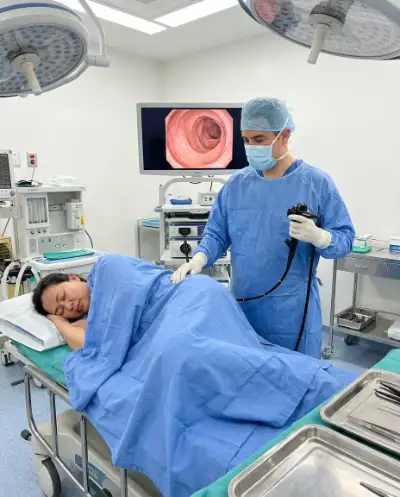
After arriving at the hospital and talking to the anesthesiologist, the patient is placed through a venous line through which he receives mild and safe intravenous sedation (sleep).

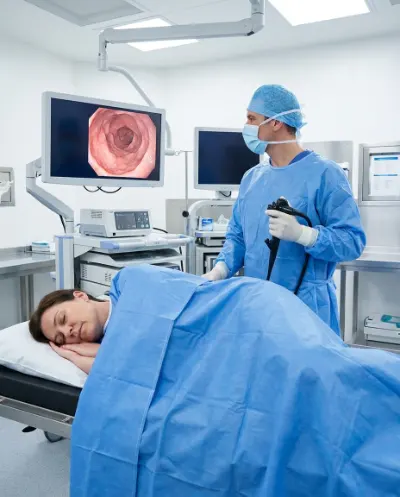
While the patient is asleep and does not feel any pain or discomfort, the doctor introduces a flexible instrument with a high-resolution camera (colonoscope) and carefully examines the entire length of the intestine.

The examination usually lasts between 20 and 40 minutes, depending on the anatomical structure of the intestine and the eventual need to take biopsies or remove polyps found.

At the end of the procedure, the patient gradually wakes up from sedation under the supervision of our medical staff, and an hour after the examination, he can go home on his own.

The advantages of medical examination at the Medical Time hospital

1

Top-notch equipment: We use the most modern endoscopic systems with high-resolution optics that enable the observation of even the finest changes on the mucous membrane.

2

Absolute comfort: All our procedures are performed exclusively under short-term anesthesia, which completely eliminates pain, fear and discomfort.

3

Experienced team of experts: Our eminent gastroenterology specialists have decades of experience in diagnostic and therapeutic endoscopic procedures.

4

Everything in one place: In case of finding pathological changes, polypectomy and pathohistological diagnostics are performed as efficiently and quickly as possible.

5

Quick recovery: Thanks to modern sedation techniques, you wake up clear and without discomfort, and after a short rest you can continue with your daily activities.

6

Maximum discretion: We approach each patient with due respect, preserving intimacy, dignity and absolute confidentiality of medical data.

Frequently asked questions about preventive colonoscopy

No. In our hospital, colonoscopy is performed exclusively under analgosedation (short-term intravenous anesthesia), so the patient sleeps and does not feel any pain or remember the procedure itself.
Recovery is extremely fast. After waking up from anesthesia, the patient remains for a short observation for about an hour. Most people return to their normal diet and activities the same day.
If the doctor sees a polyp during the examination, he removes it in the same act with the help of special instruments. It is a completely painless procedure that protects you from malignancy.
Given that you have received anesthesia (sedation), it is strictly forbidden to drive motor vehicles for the next 12 to 24 hours, and it is necessary to provide an escort for going home.
If the first examination was completely normal and you have no genetic predisposition, the next one is usually advised in 5 to 10 years. If polyps are found, the interval is significantly shortened according to the doctor's order.

Contact and scheduling

Contact us to schedule an appointment and for additional information. Our team is ready to answer all your questions.

Working hours

Weekdays09:00 - 20:00
Saturday09:00 - 17:00
Sunday10:00 - 17:00

Outpatient services, therapies and home visits are available during regular working hours.