Leg-shape classification (Artemyev A.A., 2001)
- Ideal legs
- True O-shaped curvature (varus deformity)
- False curvature
- True X-shaped curvature (valgus deformity)

True X-shaped curvature (valgus deformity) appears as a gap between the feet when the knees are firmly held together in a relaxed standing position.

This classification lets you determine your own leg shape and decide whether to correct it.
The "ideal" leg shape implies that the knees, calves and feet touch, with three gaps between them.
True X-shaped curvature is shown by a gap between the feet when the knees are firmly together in a relaxed stance. Conventionally, an axis deviation of 10–15° is considered a cosmetic issue, and more than 15° an orthopaedic one.
With pronounced curvature we already speak of valgus deformity.
Leg shape is an ethnic trait. X-shaped curvature is more common in inhabitants of European countries. People with such legs seek surgical correction about 10–15 times less often than those with O-shaped curvature.
It is hard to say how common X-legs are in the general population, but men turn to surgeons about 2–3 times more often than women.
An interesting observation: in trousers, legs with mild valgus deformity look straight. Straight legs, especially in slender people, look slightly bowed in trousers. With pronounced valgus deformity, X-legs are not only very noticeable in trousers but even make it difficult to wear clothes.
A very frequent reason for seeking surgical help, especially among men, is difficulty choosing fitted clothing.
On thorough examination, valgus deformity is accompanied by underdevelopment of the femoral or tibial condyles and by flat feet. With age these features may lead to the development and progression of various pathological conditions, so they require correction as early as possible.
You can be confident that we will achieve ideal legs in almost any case. The only question is how long this process will take. We offer three methods for correcting valgus deformity:
Express methods use intramedullary nail fixation, which significantly shortens rehabilitation — active rehabilitation can begin as early as 19 days after surgery.
If you believe you have false curvature — see the corresponding section.
The principle of surgical treatment is the same as for O-leg correction — only the direction of bone-fragment displacement is opposite.

During correction the legs may also be lengthened to improve appearance.
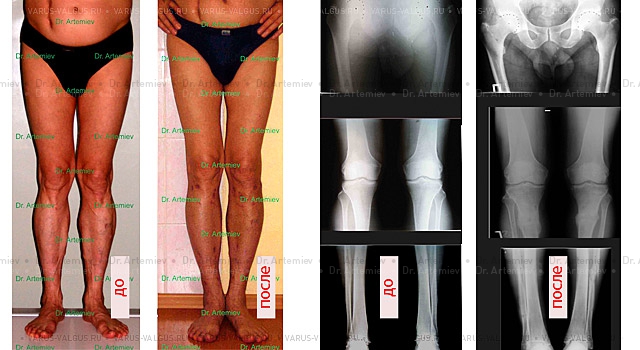
Surgical correction of the lower leg is technically simpler and has far fewer complications than thigh surgery. However, with pronounced valgus deformity the segment that is actually curved must be corrected.
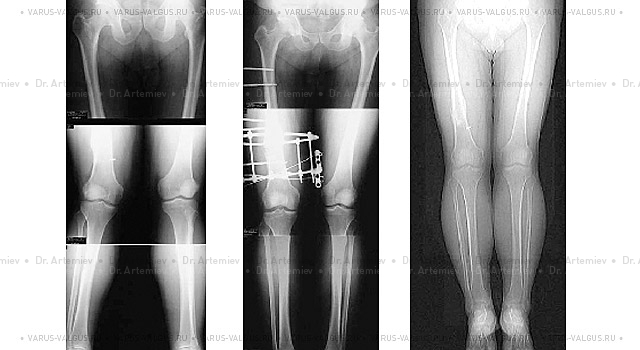
Since the principle of X-leg correction is the same as that of O-leg correction, the main features of the operation and postoperative course, as well as the treatment cost, are identical for both types of deformity.
Clinical cases of valgus knee deformity (X-legs) correction — preoperative and postoperative results performed by specialist Dr. Artemiev Alexander.
Contact us to schedule an appointment and for additional information. Our team is ready to answer all your questions.
Outpatient services, therapies and home visits are available during regular working hours.