

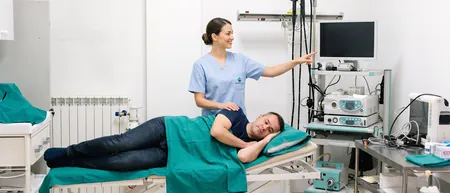
What is endoscopy?
Endoscopy is a diagnostic method in which the cavity of an organ is examined from the inside using a flexible instrument (an endoscope) with a miniature high-resolution camera and a light source at its tip. The image is transmitted to a monitor in real time, so the doctor sees the mucous membrane magnified and in full colour.
Unlike X-ray, CT or ultrasound, which show a change indirectly, an endoscopic examination is a direct view — the doctor sees the change with their own eyes and can take a tissue sample (biopsy) or remove a polyp during the same examination. That is why it confirms or rules out suspicions that imaging leaves open.
Fine instruments pass through the working channel of the endoscope — biopsy forceps, a snare for polypectomy, a catheter to stop bleeding. So endoscopy is often not only an examination but also treatment: the change is removed in the same session, without surgery and without an incision.
At Medical Time the examination is carried out in full hospital conditions, under sedation led by an anaesthesiologist. The patient sleeps through it, feels no discomfort and does not remember it, while the doctor works calmly and thoroughly — the precondition for spotting small, early changes at all.
Types of endoscopic examination at Medical Time
Our hospital performs three endoscopic examinations, all to the same standard — sedation, anaesthesiologist supervision and modern video equipment. Which one is needed depends on where the complaints are:
- gastroscopy — examination of the oesophagus, stomach and duodenum, for heartburn, stomach pain, nausea and suspected ulcer or Helicobacter pylori
- colonoscopy — examination of the colon along its whole length, for changed bowel habits, blood in the stool, anaemia of unclear cause and as the basic screening for colon cancer
- bronchoscopy — examination of the trachea and bronchi, for a persistent cough, coughing up blood and unclear shadows on a lung image
- combined examination — gastroscopy and colonoscopy in the same session of sedation, when complaints call for the whole digestive tract to be examined
- therapeutic procedures — polyp removal, stopping bleeding and retrieval of a foreign body, within the same examination
When is endoscopy performed? Symptoms and indications
Endoscopy is recommended when complaints last longer, keep coming back or do not resolve with the usual therapy, and when a laboratory result or an image needs clarification. The aim is to separate harmless conditions from those requiring treatment in good time.
The most common reasons for booking the examination are:
It is also performed without any complaints at all — as screening after the age of 45, in families with colon cancer, and to follow up changes found earlier.
- persistent heartburn, pain or burning in the upper abdomen and a feeling of fullness
- difficult or painful swallowing, persistent nausea and vomiting
- a change in bowel habits lasting more than a few weeks
- blood in the stool, black stools or anaemia without a clear cause
- unexplained weight loss and a long-lasting loss of appetite
- a persistent cough, coughing up blood or a suspicious shadow on a lung image
- a family history of stomach cancer, colon cancer or polyps
- follow-up after a previously found polyp, ulcer or inflammatory bowel disease
Preparing for an endoscopic examination
Preparation depends on which organ is being examined, but one rule applies to all: the examination is performed on an empty stomach. For gastroscopy and bronchoscopy you must not eat for at least 6 hours beforehand, and clear fluids stop 2 hours before.
Colonoscopy also requires bowel cleansing — the day before you switch to clear fluids and drink the preparation solution, following the instructions you receive when booking. How much of the mucous membrane can actually be seen depends directly on the quality of that preparation.
Because the examination is performed under sedation, you come accompanied and do not drive that day. Before the examination you sign a consent form and have a short conversation with the doctor and the anaesthesiologist.
What the doctor needs to know:
- all the medicines you take, especially blood thinners and diabetes therapy
- chronic heart and lung conditions, previous operations and all allergies, particularly to medicines and anaesthetics
- the doctor will tell you which morning medicines you may take with a little water and which to skip
- bring earlier findings, discharge letters and reports of previous endoscopic examinations
- be sure to arrange someone to accompany you home
How the examination goes and how long it takes
The examination is performed lying down. The anaesthesiologist introduces sedation, the patient falls asleep within seconds and feels nothing during the procedure. The doctor then carefully inserts the endoscope and, following the image on the monitor, examines the mucous membrane section by section — in both directions, since small changes are often noticed only as the instrument is withdrawn.
Gastroscopy usually takes 10 to 20 minutes, colonoscopy 20 to 40, and bronchoscopy 15 to 30 minutes. The whole stay, including preparation, sedation and waking up, is normally one to two hours.
Throughout the procedure the team monitors pulse, breathing, blood pressure and oxygen saturation, adding oxygen when needed. Sedation wears off quickly afterwards, so most patients wake calmly, without nausea and with no memory of the examination itself.
Biopsy and polyp removal during the examination
The greatest value of endoscopy is that diagnosis and treatment happen in one session. If the doctor spots a suspicious change, they take a small tissue sample for histopathological analysis — painless for the patient and adding little to the length of the examination.
A polyp found during colonoscopy is as a rule removed on the spot (polypectomy). This matters, because the vast majority of colon cancers develop from polyps: removing the change prevents the disease before it arises.
During gastroscopy a sample is routinely taken to detect Helicobacter pylori, and during bronchoscopy a lavage is performed for microbiological and cytological analysis. The results direct treatment precisely, instead of therapy being guessed from symptoms.
After the examination — recovery and findings
After the examination the patient rests briefly until the sedation wears off, under the supervision of our staff. Mild bloating, a passing scratchy throat or hoarseness are common and settle during the day.
You receive the report with images and recommendations immediately after the examination, while histopathology results arrive over the following days. All images and reports are stored digitally, so every further check-up can be compared with the previous one.
- do not drive or operate machinery that day because of the sedation
- you may eat and drink as soon as swallowing feels fully normal again, usually after an hour
- most patients return to their usual activities the very next day
- if a polyp was removed, the doctor gives brief instructions on diet and exertion for the following days
- contact your doctor if severe abdominal pain, heavier bleeding, difficulty breathing or fever appear
Why have your endoscopy at Medical Time
Endoscopy at our hospital is performed in full hospital conditions, with an experienced team of gastroenterologists, pulmonologists and anaesthesiologists. Everything the examination may call for — laboratory, histopathology, imaging and a specialist consultation — is available in one place, with no need to send the patient elsewhere.
Appointments are available quickly and without a referral, and findings and recommendations arrive without delay. If a change is found, treatment continues with us — from a follow-up examination to surgery, if it is needed.
- examination under sedation — the patient sleeps through it, without pain and without stress
- modern video endoscopes and high sterilisation standards
- experienced gastroenterologists and pulmonologists, with constant anaesthesiologist supervision
- biopsy and polyp removal during the same examination, without delay
- fast booking, without a referral and without long waiting
- findings and recommendations straight away, with digital storage of images and reports
- everything in one place — diagnostics, laboratory, histopathology and further treatment
Gastroscopy, colonoscopy and bronchoscopy — what is the difference
All three examinations use the same technique and are performed under sedation; they differ in what is examined and how the patient prepares.
| Examination | What is examined | Duration | Preparation |
|---|---|---|---|
| Gastroscopy | oesophagus, stomach and duodenum | 10–20 minutes | nothing to eat for 6 hours |
| Colonoscopy | the colon along its whole length | 20–40 minutes | diet and bowel cleansing the day before |
| Bronchoscopy | trachea, bronchi and airways | 15–30 minutes | nothing to eat for 6 hours |
Price — Endoscopy
The price of an endoscopic examination depends on which organ is examined, whether it is performed under sedation or local anaesthesia, and on whether a biopsy is taken or a polyp removed. A combined examination in one session of sedation is as a rule cheaper than two separate appointments.
- Gastroscopy + anaesthesia
- Colonoscopy + anaesthesia
- Bronchoscopy + anaesthesia
- Additionally: biopsy, polypectomy or lavage
For the current price and an appointment, call 062-399-888.
Frequently asked questions about endoscopy
No. At Medical Time the examination is performed under sedation led by an anaesthesiologist, so the patient sleeps through it and feels no pain. After waking, only mild bloating or a passing scratchy throat are possible.
Gastroscopy takes 10 to 20 minutes, colonoscopy 20 to 40, and bronchoscopy 15 to 30 minutes. The whole stay, with preparation, sedation and waking up, is normally one to two hours.
You should not eat for at least 6 hours before the examination, and clear fluids stop 2 hours before. Colonoscopy also requires bowel cleansing the day before, following the instructions you receive when booking.
Yes. Both examinations are performed in the same session of sedation, so the patient falls asleep once and wakes once. That is both faster and considerably easier than two separate appointments.
As a rule, yes. A polyp found during colonoscopy is removed during the same examination and sent for histopathological analysis. The change is thus dealt with before it could develop further.
No. Because of the sedation you must come accompanied and must not drive or operate machinery that day, as sedatives temporarily slow reflexes.
You receive the report with images and recommendations immediately after the examination. If samples were taken, histopathology results arrive over the following days and are interpreted by your doctor.
No. At Medical Time you can book an endoscopic examination without a referral, usually quickly and without long waiting.
Related pages
Endoscopic examinations we perform