

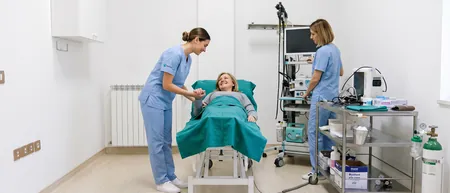
What is colonoscopy?
Colonoscopy is an endoscopic exam in which the doctor visually examines, in real time, the entire inside of the large intestine (colon) and the final part of the bowel (rectum). It is performed with a colonoscope — a thin, flexible tube whose tip carries a miniature high-resolution camera and a light source, transmitting the image to a screen magnified and sharpened.
Unlike other methods, colonoscopy is not only a diagnostic but also a therapeutic procedure: during the same exam the doctor can immediately remove polyps, take tissue samples for biopsy or stop minor bleeding — without the need for surgery.
That is exactly why colonoscopy is considered the gold standard in examining the large intestine. No other method offers such a detailed view of the lining together with the possibility of treatment. At Medical Time the exam is performed in controlled and discreet conditions, with constant monitoring of vital functions.
Why colonoscopy is performed — indications
Colonoscopy is performed both when symptoms are present and as a preventive (screening) exam in people without any complaints. Based on your symptoms, age and family history, the gastroenterologist assesses whether and when the exam is needed.
The most common reasons for which colonoscopy is recommended are:
- ✓ Blood in the stool, black or tarry stools
- ✓ A persistent change in bowel habits — prolonged diarrhea, constipation or alternating between them
- ✓ Abdominal pain or cramps of unknown cause
- ✓ Unexplained weight loss
- ✓ Anemia of unclear origin or low iron levels
- ✓ A positive test for hidden (occult) blood in the stool
- ✓ A family history of colorectal cancer or polyps
- ✓ Follow-up of known bowel diseases and a check-up after polyp removal
Which diseases and changes colonoscopy detects
The exam can detect and treat numerous changes in the lining of the large intestine, often even before they cause any symptoms:
- ✓ Polyps — growths on the lining that are removed immediately during the exam, before they turn malignant
- ✓ Colon and rectal cancer — colonoscopy is the most reliable method for early detection
- ✓ Inflammatory bowel disease (IBD) — ulcerative colitis and Crohn's disease
- ✓ Diverticula and diverticulitis (pouches on the bowel wall)
- ✓ Hemorrhoids and anal fissures as a source of bleeding
- ✓ Angiodysplasia and other sources of bleeding in the bowel
- ✓ Narrowing (strictures) and inflammatory changes of the lining
When to have a colonoscopy — screening and age
Colorectal cancer in its early stage usually causes no symptoms at all, and develops over years from harmless polyps. That is why screening colonoscopy — an exam in people without complaints — is one of the most effective ways to prevent cancer, not just detect it. By removing polyps while they are still harmless, the path toward the development of cancer is interrupted.
Current recommendations move the start of screening to earlier years, because the rise in disease is also noticeable in younger people:
- ✓ It is advisable to have the first screening colonoscopy at around age 45
- ✓ If the result is normal and there are no risk factors, the exam is repeated about every 10 years
- ✓ In people with a family history of bowel cancer, screening starts earlier and is repeated more often
- ✓ If polyps are found, a follow-up colonoscopy is usually in 3 to 5 years, depending on the findings
- ✓ In chronic bowel diseases (ulcerative colitis, Crohn's disease) exams follow a special schedule
Preparing for colonoscopy
Preparation is the most important part of the whole process. For the doctor to spot even the smallest changes, the large intestine must be completely clean. An insufficiently cleaned bowel is the most common reason for the exam to be repeated, so we advise you to follow the instructions to the letter. At Medical Time, with each appointment you receive a clear written plan and staff who are available for any question.
Preparation takes place in two parts: an adjusted diet in the days before the exam and taking a bowel-cleansing agent the day before (and if needed on the morning of the exam).
Diet before the exam — by day
The aim of the diet is to keep undigested food and fiber that would obscure the lining from remaining in the bowel.
- ✓ 3 days before: avoid high-fiber food — wholegrain bread, nuts, seeds, corn, mushrooms, fruit with pits and small seeds (kiwi, grapes, tomato), leafy vegetables
- ✓ 2 days before: lighter meals — white meat, fish, boiled rice, pasta, eggs, white bread; continue to avoid fiber
- ✓ 1 day before (the day before the exam): no solid food — only clear fluids (water, clear broth, tea, non-carbonated clear juices without pulp)
- ✓ Avoid red and purple foods and drinks, as they can stain the lining
- ✓ On the day of the exam you remain fasting, with sips of clear fluid according to the doctor's instructions
Bowel-cleansing agent — Fortrans, MoviPrep and how to drink it
For bowel cleansing, laxative solutions based on polyethylene glycol are used — most often Fortrans or MoviPrep. The solution is drunk gradually, and the correct way of taking it is decisive for the quality of the exam.
A split preparation is increasingly used — you drink one part of the solution the evening before the exam, and the other part early in the morning on the day of the exam. This schedule cleans the bowel far better and is easier to tolerate.
- ✓ Fortrans: each sachet is dissolved in 1 liter of water; usually several liters are drunk, one glass (about 250 ml) every 15 minutes
- ✓ MoviPrep: dissolved according to the package instructions and also drunk gradually, with an additional intake of clear fluid
- ✓ The solution is easier to drink chilled and through a straw; the sour taste is eased by a sip of clear juice between glasses
- ✓ Frequent bowel movements soon begin — the preparation is complete when the stool becomes a clear, yellowish fluid with no solid parts
- ✓ During cleansing be sure to replace fluids to avoid dehydration
- ✓ Stay at home, near a toilet, while the agent is taking effect
Medications, diabetes and blood-thinning therapy
You mostly continue your regular therapy, but some medications require adjustment. That is why it is important to inform the doctor before the exam about everything you take.
- ✓ Blood thinners (aspirin, clopidogrel, warfarin, new anticoagulants) — a temporary stop or replacement is decided solely by the doctor, never on your own
- ✓ Iron supplements are stopped a few days earlier because they stain the lining and make the exam harder
- ✓ Diabetes — insulin and oral medication doses are adjusted to the changed diet; bring your glucose meter and tell the staff you are diabetic
- ✓ Blood pressure and heart medications are usually taken with a small sip of water in the morning, as agreed
- ✓ Be sure to report drug allergies and earlier reactions to anesthesia or sedation
Required tests before the exam
When colonoscopy is done under sedation or with analgosedation, a short preparation is needed for the safe use of anesthesia. Exactly which tests are needed we will agree at scheduling, depending on your health condition.
- ✓ Basic laboratory blood tests (blood count, coagulation parameters)
- ✓ An ECG and, if needed, an examination by an internist/anesthesiologist in older patients and people with chronic illnesses
- ✓ A list of the medications you take and information about earlier illnesses and surgeries
- ✓ Earlier colonoscopy or histopathology findings, if you have them, bring them for review
What colonoscopy is like — the course of the exam
On the day of the exam you come prepared and fasting, accompanied if you have opted for the exam under sedation or analgosedation. After a short conversation with the doctor and, if needed, the anesthesiologist, you lie on your left side with your knees bent, and the staff continuously monitors your vital functions.
The doctor gently introduces the colonoscope through the anus and gradually guides it through the rectum, the sigmoid colon and the entire large intestine up to the junction with the small intestine. The image from the camera is followed on a screen and every part of the lining is carefully examined, both while introducing and slowly withdrawing the instrument.
The exam itself most often lasts 15 to 45 minutes, depending on the findings and on whether polyps are removed. The total stay in the facility, with preparation and a short rest, is usually about one to two hours.
- ✓ For gentle distension of the bowel, carbon dioxide (CO2 insufflation) is used instead of air — the body absorbs it quickly, so there is almost no bloating or discomfort after the exam
- ✓ Under sedation or with analgosedation the exam is completely painless and most often you do not remember it at all
- ✓ With constant monitoring of pulse, blood pressure and oxygen saturation, the procedure is safe and controlled
- ✓ Immediately upon completion you receive a verbal report, and a written report as soon as possible
Polyp removal and biopsy during the exam
The greatest advantage of colonoscopy is that diagnosis and treatment take place at the same time. If during the exam the doctor notices a polyp, it is most often removed right away — the procedure is called a polypectomy and is completely painless for the patient, because the lining of the bowel has no pain receptors to the touch.
The polyp is removed with a special snare or forceps through the working channel of the colonoscope, and the removed tissue is sent for histopathological (PH) analysis, which shows what kind of change it is. In the same way the doctor also takes a biopsy — a small sample of the lining — when they want to confirm or rule out an inflammatory or other disease.
By removing polyps while they are still harmless, the path toward the development of colorectal cancer is interrupted. That is precisely why colonoscopy is not just an exam but also a preventive measure that can stop the disease before it arises.
Possible risks and safety
Colonoscopy is a routine and very safe procedure performed millions of times a year around the world. Serious complications are extremely rare, and it is carried out in controlled conditions with an experienced team and modern equipment that further reduce every risk.
The most common occurrences are transient and harmless, while more serious events are rare:
- ✓ Mild bloating or cramps that pass quickly — further eased by CO2 insufflation
- ✓ Brief minor bleeding after polyp removal, which most often stops on its own
- ✓ Rarely: a reaction to sedation or anesthesia, which is why a careful prior assessment is done
- ✓ Very rarely (fewer than 1 in 1000): injury to the bowel wall (perforation) that may require additional treatment
- ✓ Immediately tell your doctor about severe abdominal pain, heavier bleeding or a high fever after the exam
After colonoscopy — recovery and diet
After the exam you rest briefly at the facility until the effect of the sedation passes. In most patients recovery is quick and without complaints, and any mild bloating subsides within a few hours — passing gas is normal and desirable.
If the exam was done under sedation or with analgosedation, that day you must not drive or make important decisions, so being accompanied is mandatory. You return to your diet gradually.
- ✓ Start with fluids and light meals, then return to your usual diet during the day
- ✓ The first stool most often appears only in a day or two, because the bowel was completely emptied — that is normal
- ✓ Replace the fluids you lost during preparation
- ✓ If a biopsy was taken or a polyp removed, the doctor gives instructions for further diet and any rest
- ✓ Histopathology results arrive in a few days, with a recommendation for further follow-up
Why have your colonoscopy at Medical Time
Colonoscopy is an exam in which the expertise of the team, the quality of the equipment and the patient's sense of safety matter equally. At Medical Time we bring all three together, with a quick appointment and a warm, discreet approach.
- ✓ An experienced team of gastroenterologists with a large number of successfully performed exams
- ✓ Latest-generation high-resolution video endoscopes
- ✓ The option of an exam under sedation, with analgosedation or without anesthesia — by your choice and the doctor's assessment
- ✓ CO2 insufflation for less bloating and a more comfortable recovery
- ✓ Polyp removal and biopsy during the same exam, without delay
- ✓ Preparation, laboratory and consultations in one place
- ✓ Quick scheduling without waiting and findings right after the exam
- ✓ Discretion, kindness and staff support before, during and after the exam
Colonoscopy under sedation, with analgosedation or without anesthesia
The exam can be done in three ways. Which is best for you is decided together with your doctor, depending on your health condition, your threshold of tolerance and whether polyp removal is expected. In any case, the goal is for the exam to be safe and as comfortable as possible.
| Under sedation (anesthesia) | Analgosedation | Without anesthesia |
|---|---|---|
| You are fully asleep during the exam | You are awake, but relaxed and pain-free | You are fully conscious during the exam |
| No sensation at all and no memory of the exam | Pain and discomfort reduced to a minimum | Possible passing discomfort and cramps |
| Ideal for more sensitive patients and more complex findings | The most common choice — a good balance of comfort and quick recovery | For patients who do not want sedation or for shorter exams |
| A prior assessment and tests are required | Short preparation with monitoring | No special anesthesia preparation |
| Being accompanied is mandatory; no driving that day | Being accompanied is mandatory; no driving that day | You can go home on your own and may drive |
Cost of colonoscopy
The cost of colonoscopy depends on how the exam is performed (under sedation, with analgosedation or without anesthesia) and on whether polyps are removed or a biopsy is taken during the exam. That is why we set the final price after a short consultation, so you know exactly what is included, with no hidden costs.
For a personalized offer and all information about preparation, call us — we will gladly answer every question.
- Colonoscopy without anesthesia
- Colonoscopy with analgosedation
- Colonoscopy under sedation (anesthesia)
- Polyp removal (polypectomy)
- Biopsy with histopathological analysis
All prices are on request. For an exact offer and to book an appointment call 062-399-888.
Frequently asked questions about colonoscopy
No. When done under sedation or with analgosedation, the exam is completely painless and most often you do not remember it at all. Even without sedation, most patients feel only passing discomfort or mild cramps, which are further eased by CO2 insufflation. The lining of the bowel itself has no pain receptors to the touch, so polyp removal and biopsy are painless.
The exam itself most often lasts 15 to 45 minutes, depending on the findings and on whether polyps are removed. With preparation and a short rest after the exam, the total stay in the facility is usually about one to two hours.
The day before the exam you take no solid food — only clear fluids — while you drink the bowel-cleansing agent. On the day of the exam you come fasting; the last sips of clear fluid are allowed according to the doctor's instructions, usually a few hours before the appointment. The exact timing depends on the time of your scheduled exam and will be given to you in written instructions.
Yes. At Medical Time you can have the exam under sedation (under anesthesia), with analgosedation in which you are awake but relaxed and pain-free, or without anesthesia. You choose how it is performed together with your doctor, according to your condition and wishes.
If the result is normal and you have no risk factors, a follow-up colonoscopy is most often recommended about every 10 years. If polyps are found or there is a family history of bowel cancer, the exam is repeated more often — usually in 3 to 5 years, on the doctor's recommendation.
If the exam was done under sedation or with analgosedation, that day you must not drive or make important decisions, so being accompanied is mandatory. If the exam was done without anesthesia, you can go home on your own and may drive.
Yes. Colonoscopy is a routine and very safe procedure, and serious complications are extremely rare. It is done with constant monitoring of vital functions, modern equipment and an experienced team, with a prior assessment that further reduces every risk.
Polyps are most often removed right away during the same exam (polypectomy), painlessly and without the need for surgery. The removed tissue is sent for histopathological analysis, whose result shows what kind of change it is and determines further follow-up.
It is advisable to have the first screening colonoscopy at around age 45, even without symptoms. If you have a family history of colorectal cancer or complaints such as blood in the stool, a change in bowel habits or anemia, the exam should be done earlier and without delay.
The cost depends on how it is performed (without anesthesia, with analgosedation or under sedation) and on whether polyps are removed or a biopsy is taken, so all prices are on request. For an exact offer and an appointment call 062-399-888.