

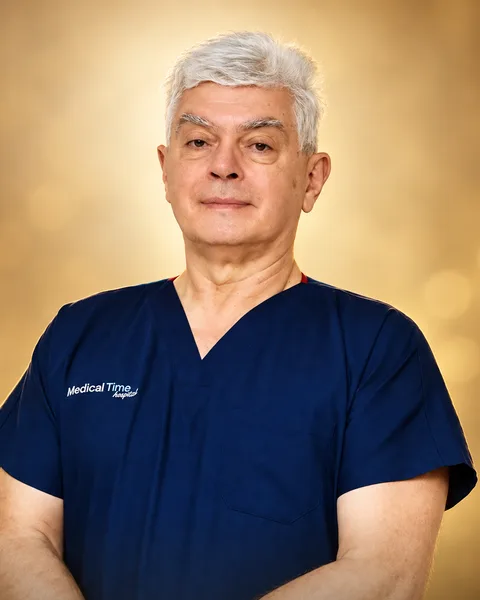
Prim. Dr Milan Petrović
General surgery specialist
- Military Medical AcademyClinic for General Surgery, since 1990
- 35+ years of experiencein the operating room
- Endocrine surgerythyroid and parathyroid glands
- Primariustitle awarded in 2010
What Dr Petrović operates on at Medical Time
With Dr Petrović you are not passed between several doctors. He examines you, decides with you whether surgery is needed, performs it and follows you at check-ups. Details about each procedure, preparation and recovery are on the pages below.
Who is Dr Milan Petrović
Dr Petrović graduated from the Faculty of Medicine in Belgrade in 1982 and completed his general surgery specialization at the Military Medical Academy in 1990. He has worked at the VMA Clinic for General Surgery ever since, and received the title of Primarius in 2010.
He has devoted most of his career to endocrine surgery, meaning operations on the thyroid and parathyroid glands. For many years he was the clinic's lead surgeon for these operations and has operated on several hundred patients.
Why does that matter? Neck surgery is precise work. The nerves that move the vocal cords run right next to the thyroid, and the parathyroid glands are the size of a grain of rice and sit slightly differently in every person. A surgeon who has done this hundreds of times knows where to look and what to protect.
Thyroid surgery with Dr Petrović
Most patients come with an ultrasound report that mentions a "nodule" and a question: do I need surgery? Often the answer is no. Dr Petrović recommends surgery only when there is a clear reason, and otherwise the nodule is monitored at regular check-ups.
When surgery is needed, the gland or one of its lobes is removed through a small incision on the lower neck, under general anesthesia. Before the operation you go through your results together and agree how much tissue to remove, because that determines whether you will take thyroid hormone afterwards and at what dose.
- a nodule that grows or a biopsy with a suspicious result
- a goiter that tightens the neck and makes swallowing or breathing harder
- an overactive thyroid (hyperthyroidism, Graves' disease) that does not settle on medication
- confirmed or possible thyroid cancer
Everything about thyroid surgery: preparation, procedure and recovery Thyroid ultrasound at Medical Time
Parathyroid surgery and hyperparathyroidism
The parathyroid glands are four tiny glands behind the thyroid that keep blood calcium under control. When one of them enlarges and releases too much parathyroid hormone, calcium rises. People feel it as constant fatigue, bone pain, thirst, kidney stones or bone loss, and it is often found by chance on routine blood tests.
This is the field where Dr Petrović has the most experience. He focuses in particular on secondary hyperparathyroidism in hemodialysis patients preparing for kidney transplantation. These are demanding operations in people who already have several conditions, so every step is planned together with the nephrologist.
- high calcium and parathyroid hormone in blood tests
- a parathyroid adenoma seen on ultrasound or scintigraphy
- secondary hyperparathyroidism in dialysis patients
- preparation for kidney transplantation
Hemorrhoid surgery and hernia repair
Alongside thyroid surgery, Dr Petrović has practised colorectal surgery for years, having trained in 1993 at the Institute for Digestive Diseases of the Clinical Center of Serbia. At Medical Time he treats hemorrhoids with the THD method: the vessels feeding the hemorrhoid are tied off with Doppler guidance, without cutting and without an open wound. Pain after the procedure is much lower than after classic surgery.
He also repairs hernias, most often inguinal and umbilical, as well as hernias that appear at the site of an earlier incision. As a laparoscopic surgery instructor since 1997, he chooses the technique for each hernia separately: in some cases open surgery is better, in others laparoscopy, and mesh is placed where the wall needs strengthening.
THD hemorrhoid surgery Hernia surgery: types, mesh and recovery
Education and training
From medical school to the title of Primarius, Dr Petrović's entire career has been tied to surgery in Belgrade.
- 1982.Graduated from the Faculty of Medicine, University of Belgrade
- 1990.General surgery specialization at the VMA and start of work at the Clinic for General Surgery
- 1993.Training in colorectal surgery at the Institute for Digestive Diseases, Clinical Center of Serbia
- 1997.Became a laparoscopic surgery instructor of the National Laparoscopic Association
- 2010.Awarded the title of Primarius
He has also completed several international advanced surgical courses and published 9 papers as author and 24 as co-author.
Professional memberships
Dr Petrović is a member of surgical associations in Serbia and the region:
- Serbian Medical Society
- Surgical Section of the Serbian Medical Society
- Yugoslav Association for Endoscopic Surgery (JUEH)
- Society of Coloproctologists of Yugoslavia
- Association of Oncological Surgeons of Serbia
How to book an appointment
Call +381 62 399 888 or send a request through the contact form and say you would like to see Dr Petrović. The practice is at Medical Time hospital, Krunska 9, Vračar, Belgrade.
Bring the results you already have: neck ultrasound, TSH and fT4, calcium and parathyroid hormone, a biopsy report if you had one, and a list of the medicines you take. If anything is missing, you can do the tests and ultrasound with us, in the same building.
Frequently asked questions
Yes. In addition to his work at the VMA, Dr Petrović sees and operates on patients at the private Medical Time hospital in Belgrade, Krunska 9, Vračar.
Several hundred. For many years he was the lead surgeon of the VMA Clinic for General Surgery for thyroid and parathyroid operations.
Yes. This is one of his special fields: surgery for secondary hyperparathyroidism in hemodialysis patients, including those preparing for kidney transplantation.
No. Most nodules are simply monitored at check-ups. Surgery is recommended when a nodule grows, when a biopsy shows a suspicious result or when a goiter presses on the neck.
Call +381 62 399 888 or send a request through the contact form. Bring the results you have, and anything missing can be done with us.