

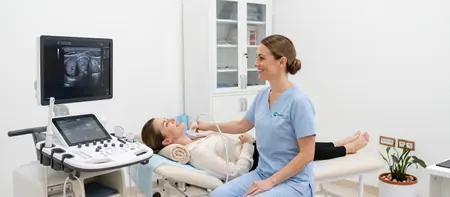
What a thyroid ultrasound shows
The thyroid sits at the front of the neck, below the larynx, and is shaped like a butterfly with two lobes. Because it lies close to the skin, ultrasound shows it very clearly. The doctor measures the length, width and depth of each lobe and calculates the volume of the gland from them.
Besides size, the doctor looks at the structure of the tissue. A healthy gland has an even, fine-grained look. With inflammation the tissue turns uneven and darker on screen, while nodules and cysts stand out as separate changes with their own borders.
Doppler, switched on during the same scan, shows blood flow through the gland and through the nodules. At the end the doctor also checks the lymph nodes on both sides of the neck, as they are part of assessing any nodule.
Ultrasound shows how the gland looks, not how it works. Whether it is overactive, underactive or normal is shown by hormone levels in the blood, which is why the two tests are usually done together.
When a thyroid ultrasound is done
The scan is done when there is a complaint in the neck, when hormone levels are abnormal, or to follow up a known nodule. It is also done when thyroid disease runs in the family. A nodule found by chance on a neck CT or a carotid Doppler also needs a scan.
The most common reasons are:
- a lump or swelling at the front of the neck that you or a doctor noticed
- abnormal hormones: TSH, FT4 or raised antibodies
- signs of an underactive gland (tiredness, weight gain, feeling cold, dry skin) or overactive gland (palpitations, tremor, weight loss, nervousness)
- tightness in the neck, difficulty swallowing or hoarseness without a cold
- follow-up of a nodule or cyst, usually every 6 to 12 months or as the doctor advises
Nodules, cysts, Hashimoto's and enlargement: what the report shows
The report describes the size of the gland, the look of the tissue and every single change with its size and position. Below are the conditions that most often lead to the scan.
Thyroid nodules and TI-RADS
Thyroid nodules are common, especially in women and after the age of 40. The vast majority are benign. To keep the assessment consistent, the doctor scores each nodule with the TI-RADS system, from TR1 (benign) to TR5 (suspicious).
The category comes from several features of the nodule:
- composition: whether the nodule is cystic, spongiform, mixed or solid
- echogenicity: how bright or dark it is compared with the surrounding tissue
- shape: whether it is taller than it is wide
- margins: smooth or irregular, and whether the change extends beyond the gland
- tiny bright spots (microcalcifications) inside the nodule
When a nodule needs a biopsy
The decision on a fine needle biopsy depends on the TI-RADS category and the size of the nodule. A low-category nodule is usually only monitored, even when it is larger. For a high-category nodule a biopsy is recommended at a smaller size, most often from 1 cm. The final recommendation comes from the endocrinologist, based on the report and hormone levels.
Thyroid cyst
A cyst is a fluid-filled cavity and looks dark with clear edges on ultrasound. A simple cyst falls into the lowest risk group. If it is large and presses on the neck, the doctor may suggest draining the fluid with a needle.
Hashimoto's thyroiditis
With Hashimoto's the gland looks uneven and darker, and sometimes as if it were full of tiny nodules. Ultrasound thus shows the inflammation, but the diagnosis is confirmed by anti-TPO and anti-TG antibodies in the blood. In Hashimoto's the gland may be enlarged, normal or smaller with age.
Enlarged thyroid (goitre)
An enlarged thyroid is called a goitre. It may be evenly enlarged or enlarged because of one or more nodules. Ultrasound measures the volume, so at follow-up it is clear whether the gland is growing. In an overactive gland, as in Graves' disease, Doppler often shows greatly increased blood flow.
Preparation and what happens during the scan
No preparation is needed for a thyroid ultrasound. You do not need to fast, and you take your thyroid medication as usual. Wear a top with an open neckline and take off any necklace.
You lie on your back with a small pillow under your shoulders, so your head tilts slightly back. The doctor puts gel on your neck and moves the probe over both lobes, then over the lymph nodes at the sides of the neck. You may be asked to swallow, because the gland then moves and its lower part is easier to see.
The scan is painless and takes about 15 minutes. Bring earlier ultrasound and hormone reports. If a nodule is already being followed, the doctor compares its current size with the earlier one, and that is the most important figure at follow-up.
Thyroid ultrasound and thyroid hormones
Ultrasound and blood tests give two different pictures. Ultrasound shows what the gland looks like, while TSH, FT4 and antibodies show how it works and whether there is autoimmune inflammation. A normal ultrasound does not rule out a hormone problem, just as normal hormones do not rule out a nodule.
At Medical Time you can have your hormones tested in the laboratory of the same hospital, so the endocrinologist can read both results together. If the ultrasound shows a nodule for which surgery is advised, we book the surgical consultation right away.
Thyroid ultrasound cost
A thyroid ultrasound costs from 6,000 RSD. The scan includes measuring the gland, TI-RADS scoring of every nodule and a check of the neck lymph nodes. Book your appointment by phone at 062-399-888. See the prices of other diagnostic tests in the price list.
- Thyroid ultrasound with TI-RADS nodule scoring
- Ultrasound of the thyroid and neck lymph nodes
- Follow-up scan of a nodule or cyst
For an appointment call 062-399-888.
Questions about thyroid ultrasound
No, a thyroid ultrasound needs no preparation. You can eat, drink and take your medication as on any other day.
The scan takes about 15 minutes. If there are several nodules to measure and score, it may take a little longer.
TI-RADS is a risk score for a nodule, from TR1 (benign) to TR5 (suspicious). Together with the size of the nodule it decides whether the nodule is only monitored or a biopsy is done.
Ultrasound shows changes typical of Hashimoto's, but the diagnosis is confirmed by antibodies in the blood. That is why anti-TPO, anti-TG and TSH are tested alongside the scan.
Most thyroid nodules are benign. Ultrasound and the TI-RADS score show which nodule only needs monitoring and which should be checked with a biopsy.
The doctor sets the interval based on the TI-RADS category and the size of the nodule. Most often it is every 6 to 12 months, and less often for stable low-category nodules.
Yes, ultrasound is safe in pregnancy because it uses no radiation. It is safe for children too.
A thyroid ultrasound costs from 6,000 RSD. Book your appointment by phone at 062-399-888. Prices of other diagnostic tests are in the price list on the website.
Related pages
Related exams and specialists: