

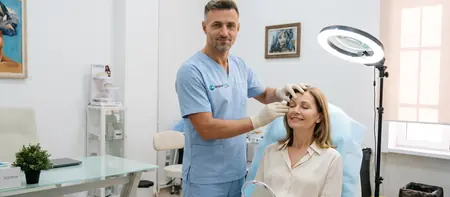
What blepharoplasty is and what it changes
Blepharoplasty is the surgical name for eyelid surgery. The surgeon removes excess skin and, if needed, reduces or repositions the fat that forms bags. The aim is a more open, rested look, not a different eye shape.
With age, eyelid skin loses elasticity and the membrane that holds the fat around the eye weakens. On the upper lid a fold forms and drops towards the lashes. On the lower lid the fat bulges and creates under-eye bags.
Surgery does not remove fine lines beside the eyes, dark circles or low eyebrows. For these the surgeon suggests another solution at the consultation or combines it with eyelid surgery.
Upper, lower or all eyelids: which operation you need
Upper eyelid surgery removes skin that hangs over the lid and makes the eyes look heavy. The incision is made in the natural crease, so the scar is not visible later when the eye is open. It is described in detail on the upper eyelid surgery page.
Lower eyelid surgery, also known as under-eye bag surgery, treats bags and loose skin below the eye. The incision runs just below the lashes or on the inside of the lid, depending on whether skin also needs to be removed. The under-eye bag surgery page explains more.
When both upper and lower lids are treated, the two operations are done in one session. You have one anaesthetic and one recovery, and the look changes evenly.
Who eyelid surgery is for
It helps most in healthy people whose eyelids change their facial expression or get in the way in daily life. The most common reasons people come in are:
- excess upper lid skin resting on the lashes
- lid skin that narrows the field of vision, especially when looking up
- bags under the eyes that do not go away after sleep and rest
- looking tired even when you feel rested
- difficulty applying make-up because of the upper lid fold
Local or general anaesthesia and how the operation goes
Surgery on only the upper or only the lower lids is usually done under local anaesthesia. You are awake, but the area around the eyes is numb. General anaesthesia is chosen for all four lids, for strong anxiety, or when the surgeon and anaesthetist plan it that way.
Before starting, while you sit, the surgeon marks how much skin will be removed. Upper eyelid surgery usually takes about an hour, and upper and lower together take longer. The wounds are closed with fine stitches.
After local anaesthesia you usually go home the same day, with someone to accompany you. After general anaesthesia the surgeon and anaesthetist decide when it is safe for you to leave.
Consultation and preparation for blepharoplasty
At the consultation the plastic surgeon examines your eyelids, brow position and how the eye closes. You will be asked about dry eye, glaucoma, thyroid disease and high blood pressure, because they affect the plan and recovery. If needed, you are referred to an ophthalmologist.
Before surgery you have basic blood tests, and for general anaesthesia also an anaesthetist review. Change blood thinners and supplements that affect clotting only as agreed with your doctor. On the day of surgery come without make-up and without contact lenses.
Recovery after eyelid surgery
In the first days the lids are swollen and bruising may appear around the eyes. Pain is usually mild and eased with ordinary painkillers. Cold compresses and sleeping with your head raised reduce swelling.
A typical recovery looks like this:
- stitches are removed after 5 to 7 days
- most swelling and bruising settle in 10 to 14 days
- most people return to desk work after about a week
- contact lenses and eye make-up after two weeks, on the surgeon's advice
- hard exercise and sun without sunglasses after three to four weeks
Risks and when eyelid surgery is not the first choice
The most common temporary problems are dry or stinging eyes, watering and a tight feeling in the lid. Less often there is bleeding under the skin, infection or an uneven result that needs a touch-up. Sudden severe eye pain, loss of vision or rapidly growing swelling after surgery need urgent attention.
If the lid droops because the muscle that lifts it is weak, not because of excess skin, that is ptosis and needs a different operation. With low eyebrows, removing skin alone does not give a good result. The surgeon tells these conditions apart at the consultation and explains what makes sense.
Cost of eyelid surgery
Upper eyelid surgery costs 105,300 RSD under local and 140,400 RSD under general anaesthesia. Lower eyelid surgery costs 140,400 RSD under local and 175,500 RSD under general anaesthesia.
Upper and lower eyelid surgery in one session costs 222,300 RSD under local and 280,800 RSD under general anaesthesia. The surgeon recommends the type of anaesthesia and the extent of surgery at the consultation.
- Upper eyelids, local anaesthesia
- Upper eyelids, general anaesthesia
- Lower eyelids, local anaesthesia
- Lower eyelids, general anaesthesia
- Upper and lower eyelids, local anaesthesia
- Upper and lower eyelids, general anaesthesia
For an appointment call 062-399-888.
Questions about eyelid surgery
Under local anaesthesia, upper eyelid surgery costs from 105,300 RSD, lower from 140,400 RSD, and upper and lower together from 222,300 RSD. Under general anaesthesia the prices are 140,400, 175,500 and 280,800 RSD.
If both bother you, a combined operation means one anaesthetic and one recovery. If the problem is only on the upper or only on the lower lids, there is no need to operate on all of them.
You feel no pain during surgery, because the area is numb or you are asleep. Afterwards pain is usually mild and eased with painkillers.
Stitches come out after 5 to 7 days, and swelling and bruising mostly settle within two weeks. The final look shows after a few months, when the scar has calmed down.
The upper lid scar lies in the natural crease and shows only when the eye is closed. On the lower lid it sits just below the lashes, or there is none outside if surgery is done from the inside.
Only upper or only lower lids are usually done under local anaesthesia. General anaesthesia is chosen for all four lids or when the surgeon and anaesthetist recommend it.
Removed skin and fat do not come back, but the skin keeps ageing. So the result usually lasts many years, and exactly how long depends on your skin, genetics and sun exposure.
Patients most often say the first week is the least pleasant because of swelling, and after that they quickly return to normal life. What they value most is looking more rested, not changed.
Related pages
More about the individual operations