

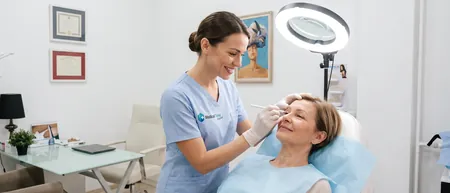
What is upper eyelid surgery (blepharoplasty)?
Upper eyelid surgery, known as upper blepharoplasty, is an aesthetic procedure that removes excess sagging skin and, if needed, a small amount of fat from the upper eyelids. This opens and refreshes the gaze, and the face gains a rested, more alert look.
With age, the skin of the upper eyelids loses elasticity and sags, beginning to fall over the edge of the eye. This gives the face a tired, serious or sad expression, and with pronounced excess skin it can even obstruct the gaze, narrowing the upper part of the field of vision. Many patients notice that their eyelids feel heavy, especially in the evening.
Blepharoplasty is one of the most rewarding aesthetic procedures because a small amount of tissue removal achieves a visible and natural rejuvenating effect. The incision is hidden in the natural crease of the eyelid, so it is practically imperceptible after healing.
At Medical Time, before the procedure it is assessed how much excess skin is present and whether the sagging comes only from the eyelid or also from drooping eyebrows, as the plan depends on this. The goal is a more open, rested gaze that looks natural, not a changed facial expression.
Who is upper eyelid surgery for — indications
The surgery is recommended when excess sagging skin of the upper eyelids permanently weighs down the gaze, gives a tired expression or obstructs vision. This is a change in the structure of the eyelid that does not improve with rest or cosmetics.
Upper blepharoplasty is considered in the following situations:
- excess sagging skin that falls over the edge of the upper eyelids
- a tired, heavy or sad facial expression due to drooping eyelids
- a feeling of heaviness in the eyelids, especially at the end of the day
- narrowing of the upper part of the field of vision with pronounced excess skin
- small fat deposits that make the eyelid puffy
- asymmetry of the upper eyelids
- a wish to refresh the gaze and rejuvenate the eye region
How upper eyelid surgery is performed — technique
The procedure is performed through a precise incision made in the natural crease of the upper eyelid, so that after healing it is hidden when the eye is open. Through this incision the surgeon removes a precisely determined strip of excess skin and, if needed, a small amount of muscle and fat that makes the eyelid puffy.
The key to a good result is precision in judging how much skin to remove — enough to open the gaze, but not too much, as excessive removal can make it harder to close the eye. That is why measurements are done carefully, while the patient is seated, with the eyes open and closed.
The incision is sutured with very fine thread, and the scar remains in the crease of the eyelid and over time becomes practically imperceptible. When the eyebrow is drooping along with the eyelid, its lifting is sometimes recommended too, as removing eyelid skin alone would not then give the full effect.
Upper eyelid surgery is often combined with lower eyelid or under-eye bag surgery, when refreshing of the whole eye region is desired. At Medical Time the plan is agreed with the patient after examination and assessment.
Preparing for upper eyelid surgery
Preparation begins with an examination and assessment of the excess skin, the position of the eyebrow and the condition of the eyes. The surgeon agrees on the extent of the procedure with the patient and explains the expected result. The procedure is most often performed under local anaesthesia, so preparation is simpler than for operations under general anaesthesia.
The following is usually requested before the procedure, with the exact scope tailored to your condition:
Honest disclosure of health details, especially eye problems and dry eye, is important for safety and the result.
- laboratory blood tests, including clotting parameters
- information about eye problems, dry eye and previous examinations by an ophthalmologist
- a list of medications you take, especially blood thinners
- stopping smoking before and after the procedure, as it slows healing
- avoiding eye make-up on the day of the procedure
- information about chronic conditions and drug allergies
- arranged escort for the return home after the procedure
The procedure, anaesthesia and duration
Upper eyelid surgery is most often performed under local anaesthesia, with mild sedation if needed, so the patient is awake and relaxed but the eye region is completely numb. For combined procedures general anaesthesia is also possible, at the team's discretion.
Before starting, the surgeon carefully marks the incision line and the amount of skin to be removed. Once the anaesthesia takes effect, the strip of excess skin is removed, along with muscle and fat if needed, and the incision is sutured with fine thread in the natural crease of the eyelid.
The procedure on the upper eyelids usually takes about an hour, and somewhat longer when combined with the lower eyelids. Because it is most often done under local anaesthesia, the patient goes home the same day, with an escort and clear care instructions.
During the procedure the eye region is tended and cooled so that swelling is as small as possible. The patient's comfort and safety come first throughout the whole procedure.
Recovery after upper eyelid surgery — realistic, phase by phase
Recovery is most often short and easy. In the first days swelling and bruising around the eyes, mild tightness and tenderness of the eyelids are expected, and sometimes a feeling of dryness or stinging in the eyes. Pain is usually mild and easily tolerated.
Cooling in the first days reduces swelling and bruising. Sutures are most often removed after about a week, after which the trace in the eyelid crease becomes increasingly hard to notice. Bruising fades during the first to second week.
Many patients return to social settings after roughly seven to ten days, once the sutures are removed and the bruising can be covered with light make-up. Fine swelling subsides gradually, and the final, refreshed appearance and the maturing of the scar are seen over the following weeks to a couple of months.
In the first days, straining, bending over, rubbing the eyes and wearing contact lenses are avoided, as instructed by the surgeon. At Medical Time, follow-up appointments monitor healing and provide care recommendations.
- first days: swelling, bruising and mild tenderness of the eyelids
- cooling the eye region to reduce swelling
- removal of sutures most often about a week after the procedure
- returning to social settings most often after seven to ten days
- final appearance and maturing of the scar over several weeks to a couple of months
Risks and possible side effects
Blepharoplasty is a precise but routine procedure with a high level of safety when performed by an experienced surgeon, and it is among the aesthetic operations with great patient satisfaction. Still, it is important to know about the possible side effects before deciding.
Possible side effects and risks include:
A precise judgement of the amount of skin and following the instructions reduce the risks. Everything is discussed openly before the procedure, with a realistic assessment.
- swelling, bruising and temporary tenderness of the eyelids
- passing dryness, stinging or increased tearing of the eyes
- temporary difficulty fully closing the eye until the swelling resolves
- asymmetry or a slight difference in the appearance of the left and right eyelid
- a visible incision trace in those whose skin tends to scar
- very rarely, infection or bleeding in the area of the eyelid
- general risks associated with anaesthesia, which are assessed before the procedure
Why have your upper eyelid surgery at Medical Time
Upper eyelid surgery requires precision and a sense of measure, as even a small detail changes the expression of the face. At the Medical Time hospital in Belgrade, the procedure is performed by an experienced team, with a careful assessment and the goal of a more open, rested gaze and a natural facial expression.
The procedure is often performed under local anaesthesia, with a short recovery and a return home the same day. From the consultation, through the assessment, to check-ups, everything is available in one place, with clear information and realistic expectations.
- an experienced team and a precise technique in the delicate area around the eyes
- the option of a procedure under local anaesthesia, with a short recovery
- an incision hidden in the natural eyelid crease for an imperceptible scar
- the possibility of combining with lower eyelid or under-eye bag surgery
- modern equipment and high standards of safety
- follow-up appointments and support during recovery
Cost — upper eyelid surgery
The cost of upper eyelid surgery depends on the extent of the procedure and on whether it is combined with lower eyelid or under-eye bag surgery. You receive the exact price and plan after a consultation and examination, when the surgeon proposes a solution tailored to you.
For an individual assessment and all information, get in touch — we will gladly answer any question.
- Upper eyelid surgery (upper blepharoplasty)
- Blepharoplasty under local anaesthesia
- Combined upper and lower eyelid surgery
For an individual assessment and an appointment, call 062-399-888.
Frequently asked questions about upper eyelid surgery
The procedure is most often performed under local anaesthesia, so the eye region is completely numb and you feel no pain during the surgery. Afterwards mild tenderness and tightness appear, which are easily tolerated.
The incision is made in the natural crease of the upper eyelid, so after healing it is hidden when the eye is open and over time becomes practically imperceptible.
Recovery is most often short. Sutures are removed after about a week, and bruising fades during the first to second week, so many patients return to social settings after seven to ten days. The final appearance is seen over the following weeks.
When the excess skin is so pronounced that it falls over the eye and narrows the upper part of the field of vision, removing the skin can open the gaze and make seeing easier. In most patients the goal is primarily aesthetic and refreshing of the gaze.
The aim of the procedure is a more open, rested gaze that looks natural, not a changed facial expression. That is why the amount of skin is removed precisely, so that the eye still closes fully and the face keeps its expression.
The result is long-lasting and lasts for years. Over time, with natural ageing, the skin may slightly relax again, but in most patients a single procedure gives a lasting refreshed appearance.
Yes. Upper eyelid surgery is often combined with lower eyelid or under-eye bag surgery, when refreshing of the whole eye region in one procedure is desired.
The price depends on the extent of the procedure and on whether it is combined with the lower eyelids, so it is set after a consultation and examination. For an individual assessment and an appointment, call 062-399-888.