

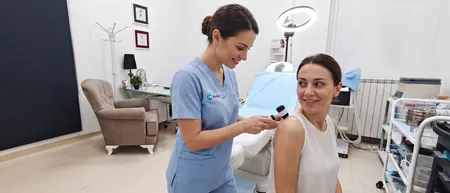
What is mole removal
A mole, or nevus, is a cluster of pigment cells in the skin most often seen as a brown or black spot, flat or slightly raised. Most people have several dozen moles that form during childhood and youth, and the great majority of them remain unchanged for life. Mole removal is a surgical procedure that completely takes the change off the skin, for either medical or aesthetic reasons.
At the Medical Time center we use surgical excision, which means the mole is removed with a scalpel together with a thin margin of surrounding healthy tissue and the associated part of the subcutaneous layer. This approach has a key advantage over removal with a laser or radiowaves: the entire removed sample stays intact and can be sent for histopathological analysis. Examination under a microscope is the only reliable way to confirm with certainty the nature of the change.
The goal of the procedure is twofold. First, to safely remove the change and obtain a clear histopathological finding. Second, to make the resulting scar as inconspicuous as possible, carefully sutured and placed so that it follows the natural lines of the skin. In most patients the incision is closed with fine sutures, and the final aesthetic result matures over the following months.
It is important to understand that mole removal is not merely an aesthetic intervention. For every removed nevus, regardless of the reason for removal, the histopathological finding gives the final word on whether the change was completely benign or required additional monitoring. That is exactly why surgical excision remains the gold standard whenever there is even the slightest suspicion.
When mole removal is indicated
There are two main reasons for mole removal: medical and aesthetic. The medical reason is always the priority and covers any mole that changes appearance or behaves unusually. Aesthetic removal is done when a mole bothers the patient because of its position or appearance, but even then we send the removed tissue for analysis.
We recommend an examination when you notice any of the signs of change. The ABCD rule helps with self-assessment: asymmetry, irregular borders, uneven color and a diameter greater than six millimeters. Still, self-assessment is no substitute for a professional examination with a dermatoscope, so it is always better to see a doctor in time.
- The mole has changed color or shape or has grown in the last few months
- The borders of the mole have become irregular or jagged
- The color within the mole is uneven, with several shades
- The mole itches, burns, bleeds or flakes
- The mole sits in a spot of constant irritation, for example under a belt or bra
- The mole gets in the way when shaving or dressing, or is aesthetically unpleasant
- A completely new, dark mole has appeared in adulthood
- There have been cases in the family of skin changes that require monitoring
How mole removal is performed
The procedure begins with a detailed examination of the skin and the mole, if needed with a dermatoscope that magnifies the change and helps the surgeon assess the margins of the excision. Once the plan is agreed, the area around the mole is disinfected and marked, and then local anesthesia is given that fully ensures painlessness during the work.
In a classic excision the surgeon removes the mole with a scalpel in a spindle-shaped incision, together with a narrow margin of surrounding healthy skin. This shape of incision allows the wound to be closed flat and tidily, without folds. The wound is then closed with sutures in one or two layers, depending on the depth and location, which reduces tension on the skin surface and encourages tidy healing.
The removed mole is immediately placed in a special solution and sent to the laboratory for histopathological analysis. This step is a mandatory part of the procedure at the Medical Time center, because only a microscopic examination gives final confirmation of the nature of the change. The finding usually arrives within a few working days, of which we inform you and interpret the result with you.
Preparation
Preparation for mole removal is simple, but a few details are important for the doctor to know in advance. At the consultation we go through your medical history, the medications you take and your tendency to form scars. Based on that, the incision technique and the way of closing the wound are planned so that the final scar is as unnoticeable as possible.
The procedure itself is most often done on an outpatient basis and does not require special fasting because it is performed under local anesthesia. Still, good skin preparation and a realistic expectation of the course of recovery contribute to a better outcome. On the day of the procedure come with clean skin, without cosmetics on the area being treated.
- Tell the doctor which medications you take, especially blood thinners and aspirin
- Mention if you are prone to thickened or keloid scars
- State any allergies, especially to local anesthetics or plasters
- On the day of the procedure come well-rested; meals before arrival are not forbidden
- Wear comfortable clothing that easily exposes the area where the mole is
- Plan not to expose the area to heavy strain for some time after the procedure
The procedure, anesthesia and duration
Mole removal is performed under local anesthesia, which is injected into the skin immediately around the change. Within a few moments the area goes completely numb and throughout the procedure you feel no pain, at most only a slight pressure or touch. Anesthesia of this kind does not affect consciousness, so you are awake the whole time and can communicate with the team.
The work on a single mole usually takes a short time, most often between fifteen and thirty minutes, depending on the size and location. If several moles are removed in the same session, the time is proportionally longer. After the removal and placement of sutures, the wound is covered with a sterile dressing and you receive clear instructions for home care.
Once the procedure is complete you can go home immediately, with no need for a hospital stay. We recommend that you avoid greater physical strain that day, and we agree on a detailed schedule of follow-ups and suture removal before you leave. The removed sample meanwhile travels to the laboratory for analysis.
Recovery
Recovery after mole removal is, as a rule, quick and without major discomfort. In the first days there may be mild tenderness, tightness or slight swelling at the incision site, which is a usual tissue reaction. The wound is kept clean and dry, dressed as agreed, and the sutures are most often removed within one to two weeks, depending on the location.
The final appearance of the scar matures gradually over several months. At first the scar may be reddish and firmer to the touch, then over time it fades and softens. Sun protection during this period is very important because a fresh scar easily darkens under the influence of UV rays. With proper care, in most patients the scar becomes barely noticeable.
- Keep the wound clean and dry and dress it according to the team's instructions
- Do not wet or rub the area until the doctor allows it
- Avoid the sauna, pool and intense training until the wound has healed
- Protect the scar from the sun with a high-factor cream for several months
- Do not remove the scab that forms on the wound yourself
- Report increased pain, redness, pus or a raised temperature
Possible risks
Mole removal is a routine and safe procedure, but like any intervention on the skin it carries a small number of possible undesirable outcomes. The great majority of them are transient and easily resolved with proper care and regular follow-ups. An open conversation about the risks before the procedure helps you have realistic expectations and recognize in time the signs that require contact.
- Minor bleeding or a bruise at the incision site in the first days
- Wound infection, recognized by redness, pain and discharge
- A thickened or more prominent scar, especially in prone individuals
- A temporary change in skin sensitivity around the incision
- The need for an additional excision if the histopathology requires it
- A slight separation of the wound edges if the area was strained too much
Why Medical Time
At the Medical Time center in Belgrade we approach mole removal seriously and systematically, combining aesthetic precision with medical safety. Every removed nevus goes for histopathological analysis, and the whole procedure is led by an experienced surgical team that clearly explains every step to you.
- Mandatory histopathological analysis of every removed mole
- An experienced surgical team and a careful technique for a tidy scar
- A detailed examination and dermoscopic assessment before the procedure
- Clear care instructions and regular follow-ups during recovery
- A pleasant environment and appointments adapted to your schedule
Price — mole removal
The price of mole removal depends on several factors, so the final amount is determined only after an examination and assessment of the change. The price is affected by the size and number of moles, their location, the complexity of the incision and the way of closing the wound, as well as whether additional processing of the sample is needed.
The price of the procedure at the Medical Time center, as a rule, also includes the histopathological analysis, which is a mandatory part of the procedure. For an accurate and individual estimate it is best to come for a consultation, where you will receive a clear plan and all the information in advance.
- Removal of one smaller mole with histopathological analysis
- Removal of a larger mole or several moles in the same session
- Follow-up examination and suture removal
For an individual estimate and an appointment, call 062-399-888.
Frequently asked questions
The procedure itself is done under local anesthesia, so during the work you feel no pain, at most only a slight pressure. Once the anesthesia wears off mild tenderness is possible, which is easily tolerated.
Yes. At the Medical Time center every removed mole goes for histopathological analysis, regardless of whether it was removed for medical or aesthetic reasons. This is the only reliable way to confirm the nature of the change.
Removal of a single mole most often takes between fifteen and thirty minutes. If several moles are removed the time is proportionally longer, but it is most often all completed in one visit.
The sutures are most often removed within one to two weeks, depending on the location of the mole and the speed of healing. We agree on the exact time before you go home.
After an excision a scar always remains, but with a careful technique and fine sutures it is reduced to the lowest possible level. With sun protection and proper care, in most patients the scar fades over time and becomes barely noticeable.
Most patients return to their usual activities the same or the next day. We recommend that in the first days you avoid greater physical strain and straining the area where the wound is.
Pay attention to changes in color, shape and size, as well as to itching, bleeding or irregular borders. If you notice any of these, it is best to book an examination, because a professional dermoscopic assessment gives a more reliable picture than self-assessment.