

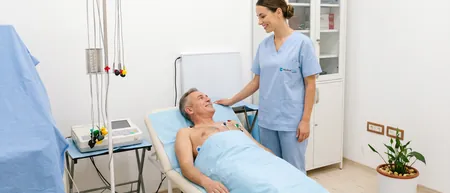
What is an ECG (electrocardiogram)?
The ECG, or electrocardiogram, is an exam that records the electrical activity of the heart — the signals that arise with each heartbeat and set the heart muscle in motion. These signals are transmitted, via electrodes placed on the chest, arms and legs, to a device that records them as a characteristic curve on paper or a screen.
From the shape of that curve the cardiologist reads a great deal: how fast or slow the heart is, whether it beats regularly, how the electrical impulse spreads through the heart and whether there are signs that a part of the heart muscle is poorly supplied with blood or damaged. That is why the ECG is the basic and most common cardiology exam.
The exam is fast, completely painless and without any radiation — electrodes are simply stuck or pressed to the body, without needles and without discomfort. That is why the ECG can be repeated as often as needed and is part of almost every cardiology and routine check-up.
At Medical Time the ECG is recorded with a modern device, and the findings are interpreted by an experienced cardiologist, so that you quickly get a reliable assessment of the heart's activity and clear recommendations for what comes next.
When is an ECG performed? Symptoms and indications
The ECG is done both for clear heart complaints and as part of regular, preventive and routine check-ups. Because of its speed and safety it is often the first exam when any heart problem is suspected.
The most common indications and symptoms for which the exam is done are:
As a general rule, any chest pain, breathlessness or feeling of an irregular heartbeat warrants an ECG — because this is how a first important view of the heart's condition is obtained quickly and painlessly.
- pain, pressure or tightness in the chest
- a feeling of palpitations, skipped beats or a fast heartbeat (palpitations)
- difficult breathing, breathlessness or tiring on exertion
- dizziness, weakness or fainting
- suspicion of a heart rhythm disorder (arrhythmia)
- high blood pressure and monitoring of heart diseases
- a check before surgery and part of routine check-ups
- tracking the effect of heart therapy and follow-up after a heart attack
Preparing for an ECG
No special preparation is needed for an ECG — you do not have to be fasting, you eat and drink normally and continue your usual therapy, unless the doctor explicitly says otherwise. It is only desirable to rest briefly and be relaxed before the exam, because exertion, rushing and agitation can temporarily speed up the heart and affect the recording.
For the electrodes to adhere well and the signal to be clean, it helps for the skin on the chest, arms and legs to be clean and dry, without greasy creams and lotions. In men with heavier body hair, the sites for the electrodes are sometimes lightly shaved for better contact.
What it is good to keep in mind before the exam:
- before the recording rest briefly and settle your breathing
- avoid coffee, energy drinks and cigarettes immediately before the exam
- do not apply greasy creams and lotions to the chest, arms and legs on the day of the exam
- wear clothing that is easy to remove down to the waist and to roll up on the arms and legs
- bring earlier ECG recordings and heart findings if you have them, for comparison
What an ECG is like — the course of the exam
The exam is performed lying down. The staff place electrodes on the chest and the wrists and ankles — small stickers or metal plates connected to the device. Placement is painless and takes only a minute or two.
Once the electrodes are in place, you need to lie still for a few seconds, relaxed and without talking, while the device records the heart's activity. The recording itself lasts only a few seconds, during which the ECG records the electrical activity of the heart from several angles at the same time.
During the recording nothing is felt — no current passes through the body; the device only listens to the signals the heart naturally produces. That is why the ECG is completely safe and can be repeated as often as needed.
Upon completion the electrodes are simply removed, and you immediately return to your usual activities. The whole exam, with placing and removing the electrodes, usually takes only a few minutes.
When you get the findings and interpretation
The ECG recording is available immediately after recording, so the cardiologist can review it without waiting. From the shape of the curve the doctor assesses the heart rhythm, the speed of the heart's activity, the way the electrical impulse spreads and any signs of poorer blood supply or earlier damage to the heart muscle.
You receive the findings with interpretation in a short time, and for urgent complaints even immediately during the exam. Based on the ECG the cardiologist gives a conclusion and recommendations — whether the findings are normal, whether additional tests are needed (for example a Holter ECG, an echocardiogram or a stress test) or therapy.
All recordings are stored digitally, so that every subsequent ECG can be compared with the previous one and you can track whether any change has occurred. If the findings require it, we immediately schedule further cardiology exams in the same place.
Why have your ECG at Medical Time
The ECG is a simple exam, but its value depends on the expert interpretation of the curve. At Medical Time the findings are interpreted by an experienced cardiologist, with a modern device, so that you get a reliable and clearly explained assessment of the heart's activity, often during the same exam.
Everything you might need after an ECG — a Holter ECG, an echocardiogram, laboratory tests or a cardiology exam — is available in one place, with a quick appointment and a warm approach.
- a fast and completely painless exam without radiation
- a modern ECG device and a precise recording of the heart's activity
- the findings are interpreted by an experienced cardiologist, with clear recommendations
- the option of interpretation right away during the exam for urgent complaints
- everything in one place — ECG, Holter, echocardiography and laboratory
- quick scheduling without waiting and findings in a short time
- digital storage of recordings for comparison over time
Cost — ECG
The cost of an ECG depends on whether only the recording is done or together with a cardiology exam and interpretation by a cardiologist, as well as on any additional diagnostics. You receive the exact price and an appointment quickly, by phone or through the contact form.
- ECG in the office (recording)
- ECG with a cardiologist's interpretation
- ECG with a cardiology exam
For the current price and an appointment call 062-399-888.
Frequently asked questions about the ECG
No. The ECG is completely painless — electrodes that listen to the heart's activity are simply stuck or pressed to the body. There are no needles, current or discomfort, and the recording lasts only a few seconds.
No. The device only records the electrical signals the heart naturally produces — no current passes through the body. That is why the ECG is completely safe and can be repeated as often as needed.
The recording itself lasts only a few seconds, and the whole exam with placing and removing the electrodes usually a few minutes. It is one of the fastest heart exams.
No. You do not have to be fasting and you continue your usual therapy. It is only desirable to rest and settle briefly before the recording, because exertion and agitation can temporarily speed up the heart.
The ECG detects heart rhythm disorders, a fast or slow heartbeat, signs of poorer blood supply to the heart muscle and traces of an earlier heart attack, as well as other changes in the spread of the electrical impulse through the heart.
The ECG records the heart's activity for only a few seconds in the office, while the Holter ECG continuously monitors the heart for 24 hours or longer. The Holter is used when complaints are occasional and a short ECG can miss them.
The recording is available immediately, so you receive the findings with the cardiologist's interpretation in a short time, and for urgent complaints even immediately during the exam. Recordings are stored digitally for comparison over time.