

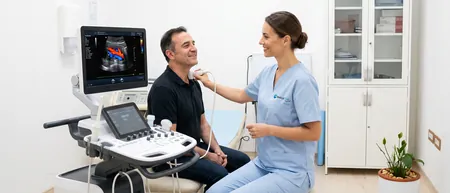
What is color Doppler?
The color Doppler is a special type of ultrasound exam that, in addition to the image of the blood vessels, also shows the flow of blood through them — in color and in real time. It uses the same, harmless ultrasound waves as classic ultrasound, but additionally measures the speed and direction of blood movement, so the doctor sees whether the blood flows freely through the vessel, flows slowly or is stopped somewhere.
On the screen the flow is shown in colors (most often red and blue) that indicate the direction of blood movement toward the probe or away from it. This clearly distinguishes healthy blood vessels from those with narrowing, blockage or dilation, as well as veins in which the blood improperly stagnates.
The exam is completely painless, without radiation and without needles, so it can be repeated as often as needed. That is why the color Doppler is one of the most useful methods for assessing the blood vessels of the legs and arms, the neck (carotid arteries), the abdomen and other regions.
At Medical Time the color Doppler is performed with a modern ultrasound device, and the exam is done and interpreted by an experienced specialist, so that you quickly get an accurate assessment of the state of the blood vessels and clear recommendations.
When is color Doppler performed? Indications
The color Doppler is recommended for complaints that point to a blood flow disturbance, as well as for the early detection of blood vessel disease before it causes pronounced symptoms. Which blood vessels are examined depends on your complaints and the doctor's assessment.
The most common indications for which the exam is scheduled are:
As a general rule, swelling, pain and cramps in the legs, varicose veins or complaints that may originate from the blood vessels warrant a color Doppler — because this is how narrowing and thromboses are detected in time, while they are still easily treated.
- swelling, pain, heaviness and cramps in the legs, especially in the calves
- varicose veins, visible venous networks and suspected chronic venous disease
- suspected deep vein thrombosis (a clot in the leg veins)
- cold legs or arms, pallor and pain on walking that resolves at rest
- assessment of the carotid arteries in the neck and the risk of stroke
- monitoring narrowing of the blood vessels (atherosclerosis) and deposits (plaques)
- checking flow after blood vessel surgery and graft implantation
- assessment of the blood vessels of the abdomen, kidneys and other organs on the doctor's recommendation
Preparing for color Doppler
For most color Doppler exams — of the blood vessels of the legs, arms and neck — no special preparation is needed. You do not have to be fasting, you eat and drink normally and continue your usual therapy. It is only desirable to wear clothing that is easy to roll up or remove from the part of the body being examined.
The exception is exams of the blood vessels of the abdomen (for example the abdominal aorta or the renal arteries), for which you are sometimes asked to be fasting for a few hours, so that air and contents in the bowel do not obscure the image. Whether preparation is needed we will tell you at scheduling, depending on what is being examined.
What it is good to keep in mind before the exam:
- for a Doppler of the legs, arms and neck no preparation is most often needed
- for a Doppler of the abdominal blood vessels it is sometimes necessary to be fasting — we will confirm at scheduling
- wear clothing that is easy to roll up or remove from the region being examined
- bring earlier Doppler and other findings if you have them, for comparison
- tell the doctor which medications you take, especially blood-thinning therapy
What color Doppler is like — the course of the exam
The exam is performed lying down or, for venous exams of the legs, sometimes standing. The doctor applies a transparent gel to the skin over the blood vessels, which improves the transmission of ultrasound waves, and then moves the probe over the region being examined.
On the screen the image of the blood vessel and the blood flow in color are shown at the same time, along with the characteristic sound of the flow. The doctor measures the speed of the blood, assesses whether there is narrowing, blockage or dilation and, for venous exams, checks whether the blood returns properly toward the heart or improperly stagnates.
The exam is completely painless; the only sensation is the coolness of the gel and a slight pressure of the probe. For some exams the doctor will ask you to change position, breathe in deeply or briefly hold your breath, in order to better assess the flow.
The color Doppler most often lasts between 15 and 30 minutes, depending on how many blood vessels and which regions are examined. Upon completion you immediately wipe off the gel and return to your usual activities, without any recovery.
When you get the findings and interpretation
The color Doppler is interpreted during the exam itself, so the doctor can tell you the main conclusions right after it is finished. You receive the written findings with a description of the state of the blood vessels, the measured flow values and recommendations shortly after the exam.
The findings state whether the blood vessels are patent, whether there is narrowing, a blockage, a clot or varicose veins, as well as how pronounced the change is. Based on this the doctor recommends further steps — therapy, a change of habits, a follow-up exam or, if needed, additional investigations.
All findings and images are stored digitally, so that every subsequent color Doppler can be compared with the previous one and you can track whether the condition is improving or progressing. If needed, we immediately schedule further exams in the same place.
Why have your color Doppler at Medical Time
The quality of a color Doppler depends both on the device and on the experience of the doctor performing it, because the exam is interpreted in real time. At Medical Time the exam is done by an experienced specialist with a modern ultrasound device, so that you get a reliable and clearly explained assessment of the blood vessels.
Everything you might need after a Doppler — a cardiology or vascular exam, laboratory tests or additional diagnostics — is available in one place, with a quick appointment and a warm approach.
- a painless exam without radiation and without needles, which can be repeated
- a modern ultrasound device with a color Doppler display of flow
- the exam is done and interpreted by an experienced specialist, with clear recommendations
- assessment of the arteries and veins of the legs, arms, neck and other regions
- for most exams no preparation is needed
- quick scheduling without waiting and findings in a short time
- everything in one place — diagnostics, consultations and further treatment
- digital storage of findings and images for tracking over time
Cost
The cost of a color Doppler depends on which blood vessels are examined (for example the veins or arteries of the legs, the carotid arteries of the neck or the blood vessels of the abdomen) and how many regions are covered. See the diagnostics prices in the price list, and for an exact offer and an appointment call us.
- Color Doppler of the leg blood vessels (veins or arteries)
- Color Doppler of the carotid arteries (neck)
- Color Doppler of the blood vessels of the arms or abdomen
For an appointment call 062-399-888.
Frequently asked questions about color Doppler
No. The color Doppler is a completely painless exam — the doctor only moves the probe over skin coated with gel. The only sensation is the coolness of the gel and a slight pressure of the probe, without needles and without radiation.
No. The color Doppler uses harmless ultrasound waves, without any radiation, so it can be repeated as often as needed and is safe even in pregnancy.
For a Doppler of the legs, arms and neck no preparation is most often needed. For a Doppler of the abdominal blood vessels it is sometimes necessary to be fasting — we will confirm this at scheduling.
The color Doppler most often lasts 15 to 30 minutes, depending on how many blood vessels and which regions are examined. After the exam you return to your usual activities immediately.
It detects narrowing and blockages of the arteries, thromboses and varicose veins, deposits on the walls of the blood vessels and flow disturbances. This way blood vessel diseases are detected in time, while they are still easily treated.
Classic ultrasound shows the image of organs and tissues, while the color Doppler additionally shows blood flow through the blood vessels in color and measures its speed. That is why the color Doppler is specifically intended for assessing the blood vessels.
The doctor tells you the main conclusions during the exam itself, and you receive the written findings with recommendations in a short time. All findings and images are stored digitally for comparison with later exams.