

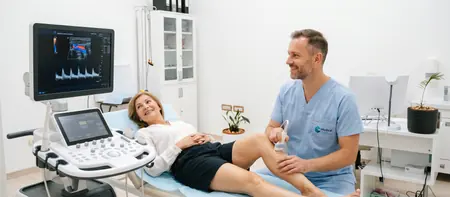
What a leg Doppler shows
A leg Doppler is an ultrasound of the blood vessels with a view of blood flow. The screen shows the vessel wall, and colours show the direction and speed of the blood. In one exam the doctor sees both the shape of the vessel and how blood moves through it.
The exam is done by a cardiovascular surgeon, a doctor who also treats vein and artery disease. So with the result you get an opinion on next steps straight away: monitoring, medication, compression stockings or assessment for a procedure.
The exam is painless, with no needles and no radiation, so it can be repeated at follow-ups as often as needed.
Venous and arterial leg Doppler
Leg veins and arteries have different diseases, so they are examined differently. Based on your symptoms the doctor decides whether to look at one system or both.
Venous Doppler of the legs
Veins carry blood from the legs back to the heart, and valves inside them stop it from flowing backwards. When the valves weaken, blood flows back and pools in the legs. That is how varicose veins, heaviness and evening swelling develop.
The doctor checks the superficial veins, the great and small saphenous veins, and the deep veins. By pressing with the probe the doctor checks whether a vein compresses, because a vein with a clot in it does not.
Arterial Doppler of the legs
Arteries bring blood to the legs. In atherosclerosis, deposits (plaques) form on the artery walls and narrow them, so the muscles do not get enough blood during effort.
The doctor follows the arteries from the groin to the foot, looks for narrowing or blockage and measures flow speed above and below it. This is the basic exam when poor leg circulation is suspected.
When to have a leg Doppler
A leg Doppler is done when symptoms point to the veins or arteries, and also in people at higher risk before symptoms appear. Smoking, diabetes, high cholesterol and high blood pressure damage arteries. Long hours standing, pregnancies, excess weight and family history strain the veins.
The most common reasons for the exam are:
- varicose veins, visible spider veins and capillaries on the legs
- evening swelling around the ankles and lower legs, and heaviness, burning, itching or night cramps in the calves
- calf pain when walking that goes away when you stop (claudication)
- cold, pale feet, slow-healing sores on the foot or lower leg and darker, thickened skin on the lower leg
- follow-up after thrombosis or after vein or artery surgery, and assessment before treating varicose veins
When it is urgent: deep vein thrombosis
Deep vein thrombosis (DVT) is a blood clot in a deep vein of the leg. It is more common after surgery, long bed rest or long journeys, in pregnancy, with hormone therapy and with cancer.
The typical sign is swelling of one leg only, with pain or tightness in the calf, warmth and redness of the skin. With these symptoms a doctor should see you the same day. A Doppler shows whether there is a clot and how far it extends.
If along with leg swelling you feel short of breath, have chest pain, a racing heart or cough up blood, call an ambulance on 194 immediately. These can be signs that part of the clot has travelled to the lungs (pulmonary embolism). This condition is not something for a scheduled exam.
You also need emergency help if a leg suddenly becomes cold, pale, painful and numb. This can be a sudden blockage of an artery.
How to prepare for a leg Doppler
A leg Doppler needs no special preparation. You eat, drink and take your medication as usual.
Wear clothes that are easy to take off, because the legs are examined from the groin to the feet. Remove compression stockings before the exam.
Bring earlier Doppler results, discharge letters and a list of medicines. Tell the doctor if you take blood thinners or have had thrombosis before.
What the exam looks like and how long it takes
Arteries are usually examined while you lie on your back. Veins are also examined while you stand, because that shows best whether blood in the veins flows backwards.
The doctor applies gel and moves the probe along the vessels. During the venous exam the doctor may squeeze your calf or ask you to bear down, and watches whether the valves hold the blood. You will hear the sound of blood flow during the exam, which is normal.
The exam does not hurt. It usually takes 20 to 40 minutes, depending on whether veins, arteries or both are examined, in one leg or both. Afterwards you go straight back to your day.
What the Doppler report shows
The doctor tells you the main conclusions during the exam, and you receive the written report shortly afterwards. The report and images are stored digitally, so every follow-up is compared with the previous one.
The report describes whether the valves of the superficial and deep veins leak, and at what level (venous insufficiency). It also covers varicose veins and their course, which is the basis for a treatment plan. If a vein has a clot, the report states where it is and whether it is fresh or older.
For the arteries, the report describes plaques and the site and degree of any narrowing or blockage. The doctor also measures blood flow speed above and below a narrowing.
After the report
Based on the result, the cardiovascular surgeon suggests the next steps. These may be changes in habits, compression stockings, medication, a follow-up exam or assessment for a procedure. If you need blood tests or a cardiology exam, they are booked in the same hospital.
Cost of a leg Doppler
A leg Doppler performed by a cardiovascular surgeon costs 8,000 RSD. The doctor decides from your symptoms whether veins, arteries or both are examined. We confirm the price for your case when you book.
- Venous Doppler of the legs
- Arterial Doppler of the legs
- Cardiovascular surgeon exam with Doppler
Leg vascular Dopplerfrom 8,000 RSD
View the current price in our price listFor an appointment call 062-399-888.
Frequently asked questions about leg Doppler
A leg Doppler with a cardiovascular surgeon at Medical Time costs 8,000 RSD. For an appointment call 062-399-888.
No. You do not need to fast, and you take your medication as usual. Remove compression stockings before the exam and bring earlier results.
No. The doctor only moves the probe over skin with gel. During the venous exam the doctor may squeeze your calf, which is uncomfortable only if the leg is already sore.
Usually 20 to 40 minutes. One system in one leg is quicker, while veins and arteries in both legs take longer.
Yes. Doppler is the basic exam when deep vein thrombosis is suspected, because it shows the clot and whether the vein compresses under the probe. If you have leg swelling together with shortness of breath or chest pain, call an ambulance on 194.
At Medical Time a leg Doppler is performed by a cardiovascular surgeon. Because this specialist also treats vein and artery disease, you get a treatment proposal together with the result.
Yes, especially if you are considering treatment. A Doppler shows which veins leak and at what level, which cannot be seen with the naked eye, and the choice of treatment depends on it.
A leg Doppler assesses the veins and arteries of the legs, while a carotid Doppler looks at the neck arteries that carry blood to the brain. The method is the same, but the reasons and findings differ.
Related pages
Related exams and specialists: