

Stroke symptoms: call an ambulance now
A carotid Doppler is a planned test and is not done while symptoms are happening. If you or someone near you suddenly develops any of the signs below, call the ambulance on 194 straight away. Every minute counts, even if the symptoms pass quickly.
- one side of the face drooping or a lopsided smile
- weakness or numbness in an arm or leg on one side of the body
- slurred or confused speech
- sudden loss of vision in one eye
- a sudden, very severe headache or loss of balance
What a neck artery Doppler examines
On each side of the neck runs a common carotid artery. It splits into the internal carotid, which supplies the brain, and the external carotid, which supplies the face and neck. At the back, alongside the spine, two vertebral arteries feed the rear part of the brain.
A carotid Doppler shows all of these arteries in one scan. Ultrasound gives an image of the artery wall, and colour Doppler shows in colour how blood flows through it. The machine measures flow speed, and from this the doctor estimates how severe any narrowing is.
The doctor measures the thickness of the inner artery wall (IMT), an early sign of atherosclerosis. For any plaque, they describe its location, size and appearance. They give the narrowing of the internal carotid artery as a percentage. In the vertebral arteries they assess flow direction and speed. After earlier surgery or a stent, they check whether the arteries are open.
Who should have a carotid Doppler
Carotid narrowing causes no symptoms for a long time. That is why the scan is usually done in people with risk factors, before any symptoms appear. Plaque in the neck often means similar changes exist in the arteries of the heart and legs. The scan is also used as a check-up after carotid surgery or stenting and as an assessment before heart surgery.
A neck artery Doppler makes sense in these situations:
- high blood pressure, high cholesterol or diabetes, and smoking for many years
- coronary artery disease or disease of the leg arteries
- a bruit in the neck heard by a doctor with a stethoscope
- past short-lived symptoms, such as brief arm weakness or temporary blindness in one eye
- stroke at a younger age in the family
Dizziness and Doppler
People often ask for a Doppler because of dizziness. Dizziness usually comes from the inner ear, blood pressure or the neck spine, not from narrowed arteries. Scanning the vertebral arteries can still rule out a flow problem, so a doctor may recommend it alongside other tests. A neurologist consultation is also useful for dizziness.
Preparation and what happens during the scan
No preparation is needed for a carotid Doppler. You do not have to fast, and you take your usual medication, including blood thinners. Remove any necklace and wear a top with an open collar.
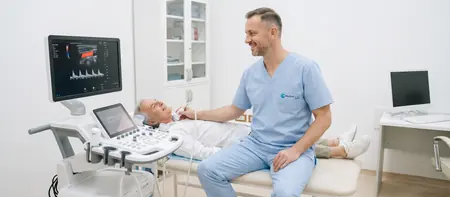
You lie on your back with your head tilted slightly back and turned away from the side being scanned. The cardiovascular surgeon applies gel to the neck and follows the arteries with the probe from the collarbone up to the angle of the jaw, first on one side and then the other.
The scan takes 20 to 30 minutes and does not hurt. You only feel light pressure from the probe on your neck. Afterwards you can drive and return to your day.
Understanding the report: plaque and degree of narrowing
The report states whether the arteries are open, how thick the wall is and whether there is plaque. Each narrowing is given as a percentage. Mild narrowing is usually monitored with follow-up scans and by treating risk factors: blood pressure, cholesterol, blood sugar and smoking.
Severe narrowing of the internal carotid needs an assessment of whether surgery or a stent is required. The vascular surgeon decides this based on the degree of narrowing, the look of the plaque and your symptoms. The surgeon tells you the main findings during the scan, and you receive the written report shortly after.
When plaque is found in the neck, the doctor often suggests checking the arteries of the heart and legs, as well as a blood lipid test. You can have these tests in the same hospital.
Carotid Doppler cost
A vascular Doppler performed by a cardiovascular surgeon at Medical Time costs 8,000 RSD. For the neck, the scan covers the carotid and vertebral arteries on both sides and includes a written report. If the leg arteries or veins also need checking, mention it when booking.
- Doppler of the carotid and vertebral arteries (neck arteries)
Carotid Dopplerfrom 8,000 RSD
View the current price in our price listFor an appointment call 062-399-888.
Questions about carotid Doppler
A neck artery Doppler at Medical Time costs 8,000 RSD. It is performed by a cardiovascular surgeon, and the written report is included.
Yes, in practice it is the same scan. It covers the carotid arteries and usually the vertebral arteries on both sides of the neck.
No, no preparation is needed. Eat normally and take your medication, and remove any necklace or scarf before the scan.
A carotid Doppler takes 20 to 30 minutes and does not hurt. You only feel the gel and light pressure from the probe on your neck.
Doppler is the first-line test because it uses no radiation or contrast and can be repeated. CT or MR angiography gives a more detailed picture and is done when a doctor requests it, usually before planned surgery.
Sometimes, but rarely. Dizziness more often comes from the ear, blood pressure or the neck spine, so the Doppler is done alongside a neurologist's or another doctor's assessment.
It depends on the findings. With mild narrowing a follow-up is usually done every one or two years, and more often with more severe narrowing, as the surgeon advises.
Plaque without significant narrowing is usually treated with medication and lifestyle changes. With severe narrowing, a vascular surgeon assesses whether surgery or a stent is needed.
Related pages
Related tests and doctors