

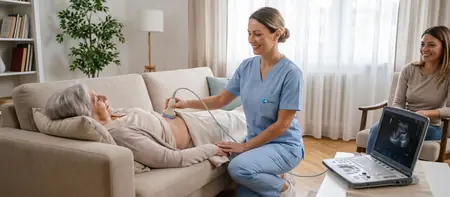
What home ultrasound is
Home ultrasound is the same exam you would have in a clinic, except the doctor comes to the patient. The specialist brings a portable ultrasound device, a probe and gel, and examines the patient in bed or in an armchair.
The portable device fits in a bag, and the image appears on its screen during the exam. The doctor reads it on the spot while moving the probe, just as in the hospital.
An exam at home does not replace hospital diagnostics in every case. If the doctor sees something that needs a CT scan, an MRI or urgent treatment, they will tell you right away and explain the next step.
Who home ultrasound is for
Home ultrasound makes sense when getting to the hospital is harder than the exam itself. Moving a bedridden person takes a patient transport vehicle, a stretcher and several helpers. For a frail patient it is also a physical strain that can be felt for days.
Families and carers most often book it for bedridden or barely mobile patients, such as after stroke or hip fracture. It also helps elderly people for whom the trip to a clinic is tiring or risky. People with dementia benefit too, as they become restless in unfamiliar places.
In the first weeks after surgery a patient often needs a check but cannot move much. For palliative patients the goal is to clarify a symptom with as little burden as possible.
Common reasons for the exam
The patient's doctor usually asks for an ultrasound when the condition changes and a clinic trip is not realistic. A typical reason is pain, bloating or fullness in the abdomen, or suspected gallstones or kidney stones. The exam is also requested when the patient passes less urine than usual or the bladder may not be emptying.
Ultrasound also shows swelling, a lump or a fluid collection in soft tissue. It is used to follow up a finding made earlier in hospital as well.
What can be examined at home
With a portable device the doctor examines areas that are easy to reach while the patient lies down. Before the visit we agree on what will be examined, based on the symptoms and the instructions of the patient's doctor.
If you need an exam that is not on this list, mention it when booking. We will tell you whether it can be done at home or only in the hospital.
Abdominal ultrasound at home
The doctor examines the liver, gallbladder, pancreas and spleen. An abdominal ultrasound at home shows gallstones, an enlarged or fatty liver, free fluid in the abdomen and other changes that explain pain or bloating.
Kidneys and bladder
In the kidneys the doctor checks their size, stones and widening of the collecting system, which appears when urine cannot drain freely. In the bladder the doctor measures how much urine is left after voiding. This matters for older men and for patients who lie in bed for long periods.
Soft tissue
The doctor examines lumps and swelling under the skin, fluid collections, lymph nodes and the area around a surgical wound. After surgery this shows whether fluid is building up under the wound.
How to prepare for ultrasound at home
Preparation depends on the area. For an abdominal ultrasound the patient does not eat for 6 to 8 hours beforehand and may drink water in small sips. That is why the abdominal exam is easiest in the morning, before breakfast.
For a bladder exam the bladder should be full. The patient drinks half a litre to a litre of water an hour before the exam and does not pass urine. If the patient has a urinary catheter, mention it when booking and the doctor will tell you what to do.
Soft tissue needs no preparation. Do not stop regular medication without talking to the doctor who prescribed it. If the patient has diabetes, ask the doctor how to adjust meals and medication to the fasting.
At home it helps to have ready:
- clear access to the bed, from both sides if possible
- good light and a power socket nearby
- earlier findings, discharge letters and a list of medicines
- a family member or carer who can help turn the patient
What the home exam looks like and how long it takes
The doctor arrives at the agreed time. First they talk briefly with the patient or family about symptoms, medication and earlier findings.
The patient lies on their back, and the doctor applies gel to the skin and moves the probe over the area. If needed, the doctor asks the patient to take a deep breath or to turn onto their side with help. When the patient cannot cooperate, the doctor adjusts the probe position and does not ask for effort the patient cannot manage.
The exam is painless and uses no radiation. The patient feels only the cool gel and light pressure from the probe. The exam itself usually takes 15 to 30 minutes, and with the conversation and setup the doctor stays a little longer.
Results after the home exam
The doctor tells the patient or family the main conclusions during the exam. You receive a written report with the description and recommendations shortly afterwards.
The report and images are stored digitally. The next ultrasound, at home or in the hospital, can then be compared with this one to see whether anything has changed.
If the result calls for further tests, Medical Time hospital has a laboratory, additional diagnostics and specialists under one roof. For patients who stay at home there are also doctor home visits and home nursing care.
How to book an ultrasound at home
You book an ultrasound at home by calling 062-399-888. The exam takes place at the patient's address in Belgrade.
After the call we agree on a time and give you preparation instructions. It helps to have ready:
- the address, the floor and whether the building has a lift
- which area should be examined and why
- whether the patient is bedridden, recovering from surgery or in palliative care
- which medicines the patient takes and whether they have a urinary catheter
- the phone number of the person who will be with the patient
Cost of ultrasound at home
An ultrasound at home in Belgrade costs 14,000 RSD. Which areas are examined in your case is agreed when booking, before the doctor's visit.
- Abdominal ultrasound at home
- Kidney and bladder ultrasound at home
- Soft tissue ultrasound at home
Ultrasound at homefrom 14,000 RSD
View the current price in our price listFor an appointment call 062-399-888.
Frequently asked questions about home ultrasound
Yes. A specialist comes to the address in Belgrade with a portable device and performs the exam at the patient's bedside. The abdomen, kidneys, bladder and soft tissue are the most common areas examined at home.
An ultrasound at home costs 14,000 RSD. Which areas are examined is agreed when you book on 062-399-888.
For the abdomen, kidneys, bladder and soft tissue a portable device in most cases gives an image good enough for assessment. If the doctor thinks a question needs a hospital exam or another method, they will tell you after the exam.
The patient does not eat for 6 to 8 hours before the exam and may drink water in small sips. Do not stop regular medication without asking the doctor, and with diabetes ask how to adjust the treatment.
The exam itself usually takes 15 to 30 minutes. With the conversation about symptoms and the setup, the doctor stays a little longer.
No. The exam is painless, uses no radiation, and the patient stays in their own bed. That is why home ultrasound is also done for palliative patients, when the goal is to clarify a symptom with as little effort as possible.
The doctor tells you the main conclusions during the exam, and the written report follows shortly. The report and images are stored digitally for comparison with later exams.
No. With sudden severe abdominal pain, vomiting blood, loss of consciousness or difficulty breathing, call an ambulance on 194. Home ultrasound is a scheduled exam, not emergency treatment.
Related pages
Related exams and home services: