

What is a prostate ultrasound?
The prostate is a walnut-sized gland that sits below the bladder and surrounds the first part of the urethra. That is why any change in its size quickly affects urination.
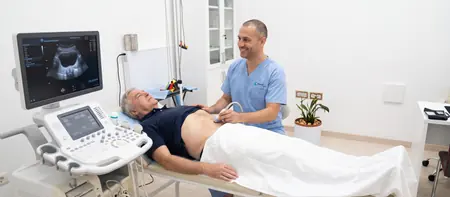
At our hospital a prostate ultrasound is done through the abdomen (transabdominally). The doctor places the probe on the lower abdomen, and a full bladder acts as a window through which the prostate is seen behind it. There is no radiation and nothing is inserted into the body.
Besides the prostate itself, the doctor always examines the bladder: its wall, its contents and how well it empties. These details show best how much an enlarged prostate interferes with urination.
When is a prostate ultrasound done
Prostate enlargement (benign prostatic hyperplasia) is common after the age of 50 and develops gradually. Many men get used to the symptoms and do not mention them for a long time.
If you cannot pass urine at all and your bladder is full and painful, this is an emergency. Call emergency services on 194 or go to the nearest emergency department. The same applies to high fever with painful urination and chills.
A scan is worth having if you notice any of these signs:
- a weak or interrupted stream, or having to wait and strain for urination to start
- needing to pass urine often, especially at night
- a feeling that the bladder has not emptied completely
- a sudden strong urge to urinate, sometimes with dribbling
- a raised PSA in a blood test, or follow-up of prostate size during treatment
Preparing for a prostate ultrasound
Your bladder should be full. Drink 1 to 1.5 litres of water about an hour before the scan and do not pass urine until your appointment. With urinary symptoms this can be hard to manage, so tell us when you book and we will adjust the instructions.
You do not need to fast, unless you are also having an abdominal ultrasound.
- drink plain water and avoid fizzy drinks and large amounts of coffee
- take your prostate medicines and other medicines as usual
- bring a list of the medicines you take
- bring your latest PSA result and earlier ultrasound reports, if you have them
How the scan and residual urine measurement work
You lie on your back and the doctor applies gel to the lower abdomen, above the pubic bone. The probe is placed lengthwise and across to measure the prostate in three directions. From these measurements the device calculates the volume of the gland.
The doctor then examines the bladder: wall thickness, any stones and whether the prostate presses into the bladder.
At the end you go to the toilet and pass as much urine as you can. The doctor then places the probe again and measures how much urine is left in the bladder. This is the post-void residual, one of the most useful figures when urination is difficult.
The whole scan, including the toilet break between the two measurements, takes 15 to 20 minutes and does not hurt. Only the pressure of the probe on a full bladder may feel uncomfortable.
What the prostate ultrasound report shows
The report states the prostate volume in millilitres. In younger adult men it is usually up to about 25 ml, and it gradually grows with age. Size alone does not tell the whole story: some men with a large prostate pass urine without much trouble, while others with a smaller one have marked symptoms. So the doctor reads the result together with the bladder findings.
For the bladder, the doctor measures residual urine. Less than about 50 ml is usually considered acceptable, while a larger amount means the bladder is not emptying well. A thickened bladder wall may mean the bladder has been working against resistance for a long time. The report also notes a middle lobe of the prostate pressing into the bladder. Bladder stones, which form more often when urine is retained, are described too. Calcifications in the prostate are common and usually harmless.
A scan through the abdomen shows the size of the prostate and its effect on the bladder well, but it cannot confirm or rule out prostate cancer on its own. That requires a PSA test, a urologist's assessment and other methods the urologist decides on.
You hear the main conclusions right after the scan, and you receive the written report shortly afterwards. Reports and images are stored digitally, so a follow-up easily shows whether the prostate has grown.
Prostate ultrasound, PSA and a urologist
PSA is a blood test that measures prostate-specific antigen. A raised PSA can have several causes: an enlarged prostate, inflammation or, less often, a tumour. The prostate volume from the ultrasound helps the urologist judge whether the PSA value fits the size of the gland.
You can have your PSA done in our laboratory. Before the blood test, ask what to avoid for a day or two beforehand, such as cycling or ejaculation, as they can temporarily raise the value.
With your ultrasound and PSA results, the best next step is a urologist. The urologist assesses your symptoms, decides on treatment and on whether further tests are needed, including a different ultrasound approach. The laboratory, ultrasound and urologist are in the same hospital, so your results do not have to travel between clinics.
Prostate ultrasound cost
A prostate ultrasound costs from 6,000 RSD. Book your appointment by phone at 062-399-888. If you also plan a PSA test or a urologist consultation, mention it when you book. See the other diagnostics prices in the price list.
- Prostate and bladder ultrasound with residual urine measurement
- PSA blood test
- Urologist consultation
For an appointment call 062-399-888.
Prostate ultrasound questions
It is done through the abdomen, with a full bladder. The doctor measures the prostate and bladder, you then pass urine, and the doctor measures how much urine is left.
Come with a full bladder. Drink 1 to 1.5 litres of water about an hour before the scan and do not pass urine until your appointment. You do not need to fast.
No. A scan through the abdomen involves no needles and nothing inserted into the body. Only the pressure of the probe on a full bladder may feel uncomfortable.
Residual urine is the urine left in the bladder after you pass water. Less than about 50 ml is usually considered acceptable, and the doctor interprets the value according to your age and symptoms.
In younger adult men the prostate is usually up to about 25 ml, and it grows with age. How well the bladder empties and what symptoms you have matter more than size alone.
A scan through the abdomen cannot reliably detect or rule out prostate cancer. It shows the size and shape of the gland, while cancer is assessed with PSA, a urologist's examination and methods the urologist chooses.
A scan through the abdomen is simpler and enough to measure prostate size and residual urine. A transrectal ultrasound gives a more detailed image of the prostate tissue and is used for targeted investigations. A urologist decides whether you need it.
A prostate ultrasound costs from 6,000 RSD. Book your appointment by phone at 062-399-888. You can book a PSA test or a urologist consultation in the same call. Prices of our other diagnostics are in the price list.
Related pages
Related exams and doctors