

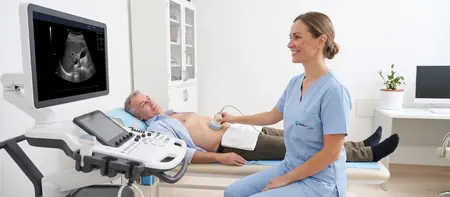
What an abdominal ultrasound examines
An abdominal ultrasound shows the organs of the upper abdomen. The doctor moves the probe across your belly and assesses the size, shape and structure of each organ on the screen. The scan uses no radiation, so it can be repeated whenever needed.
A standard scan covers the liver, gallbladder and bile ducts, pancreas, spleen and both kidneys. The doctor also sees the abdominal aorta and checks for free fluid in the abdomen.
Liver ultrasound
A liver ultrasound shows the size and texture of the liver. The most common finding is fatty liver (steatosis), which looks brighter than healthy tissue. Cysts, haemangiomas and other focal lesions are also visible, as are signs of chronic liver disease.
Gallbladder ultrasound and gallstones
Ultrasound is the first test when gallstones are suspected. Stones appear as bright spots that cast a shadow and move when you change position. The doctor measures the thickness of the gallbladder wall, looks for polyps and checks whether the bile ducts are widened.
Pancreas and spleen
The pancreas lies deep, behind the stomach, so gas in the bowel sometimes hides part of it. That is why fasting before the scan matters. The spleen is measured, because an enlarged spleen goes with some blood disorders, infections and liver diseases.
Kidneys
The kidneys are part of every abdominal ultrasound: the doctor checks their size and looks for stones and cysts. When symptoms relate to urination, a dedicated ultrasound of the kidneys and urinary tract is done with a full bladder.
When a stomach ultrasound is done
Doctors usually request an abdominal ultrasound when symptoms may come from the liver, gallbladder or pancreas. It is also used to follow up an earlier finding.
Sudden, severe abdominal pain with fever, vomiting or yellow skin needs emergency care, not a booked appointment. In that case call 194, the emergency number in Serbia.
The most common reasons are:
- pain under the right ribs, especially after a fatty meal
- bloating, nausea and a heavy feeling in the upper abdomen
- raised liver enzymes (AST, ALT, GGT) or bilirubin, or yellowing of the skin and the whites of the eyes
- unexplained weight loss or a palpable lump in the abdomen
- follow-up of known gallstones, a cyst or fatty liver, or a preventive check
How to prepare for an abdominal ultrasound
You come for an abdominal ultrasound after fasting for 6 to 8 hours. On an empty stomach the gallbladder is full and easy to see. After a meal it empties and contracts, so a stone or polyp can be missed.
The easiest option is a morning appointment without breakfast. If your appointment is in the afternoon, have a light breakfast early in the morning and nothing after that.
Before the scan:
- fast for 6 to 8 hours, with no chewing gum or sweets, but a little plain still water is fine
- the day before, avoid fizzy drinks, beans, cabbage and other foods that cause bloating
- take your regular medication with a little water unless your doctor says otherwise
- if you have diabetes and use insulin or tablets, ask how to adjust fasting when you book
- bring earlier ultrasound reports and blood test results
How the scan is done and how long it takes
You lie on your back with your belly uncovered. The doctor applies gel and moves the probe over the upper abdomen, under the ribs and over the flanks.
During the scan the doctor asks you to breathe in deeply and hold your breath. As you breathe in, the liver and gallbladder move down below the ribs and are easier to see. Sometimes you will be asked to turn onto your left side so that bowel gas shifts.
The scan does not hurt. If the gallbladder is inflamed, pressure from the probe over it can be uncomfortable, and that is useful information for the doctor.
An abdominal ultrasound takes 15 to 30 minutes, and a little longer with Doppler. Afterwards you can eat straight away and carry on with your day.
What the abdominal ultrasound report shows
The doctor tells you the main conclusions during the scan. You receive the written report shortly afterwards, and the images and report are stored digitally for comparison at your next check-up.
The report most often describes fatty liver and its degree. In the gallbladder the doctor looks for stones, sludge and polyps, and a thickened wall as a sign of inflammation. Widened bile ducts are noted as well. The report also records liver and kidney cysts, which are usually harmless, and an enlarged liver or spleen. It also notes kidney stones, a dilated kidney collecting system and free fluid in the abdomen.
Ultrasound does not show the inside of the stomach and bowel well, because they contain air. An ulcer, gastritis or changes in the lining need an endoscopy, for example a gastroscopy. The doctor reads the ultrasound result together with your symptoms and blood tests.
Abdominal ultrasound with Doppler and other combinations
Doppler is an add-on to ultrasound that shows blood flow through the vessels. It is done in the same appointment with the same probe and adds a few minutes to the scan. Preparation is the same as for the abdomen: fasting for 6 to 8 hours.
Abdominal ultrasound with portal vein Doppler
The portal vein carries blood from the bowel to the liver. Doppler measures its width and the speed and direction of flow. It is done in cirrhosis and other chronic liver diseases, with an enlarged spleen or suspected portal hypertension, and when a clot in the portal vein is suspected.
Abdominal ultrasound with renal artery Doppler
The renal arteries supply blood to the kidneys. Narrowing of these arteries can raise blood pressure. This Doppler is usually requested for high blood pressure that does not respond to several medicines, for hypertension at a young age and when the two kidneys differ in size.
Abdominal and scrotal ultrasound
This combination is for men who have abdominal symptoms together with swelling, pain or a lump in the scrotum. Both scans are done in one visit. Sudden, severe testicular pain cannot wait for an appointment: go to the emergency department straight away.
Abdominal ultrasound cost
A standalone abdominal ultrasound costs from 6,000 RSD. Combinations with a portal vein Doppler, a renal artery Doppler or a scrotal ultrasound are also from 6,000 RSD. Book your appointment by phone at 062-399-888. Prices of other diagnostics are in the price list.
- Abdominal ultrasound
- Abdominal ultrasound with portal vein Doppler
- Abdominal ultrasound with renal artery Doppler
- Abdominal and scrotal ultrasound
For an appointment call 062-399-888.
Abdominal ultrasound: frequently asked questions
A standalone abdominal ultrasound costs from 6,000 RSD. Combinations with a portal vein Doppler, a renal artery Doppler or a scrotal ultrasound are also from 6,000 RSD. Book your appointment by phone at 062-399-888.
Yes, for 6 to 8 hours without food. An empty stomach means a full gallbladder and less gas, so the doctor sees the gallbladder and pancreas more clearly. You may drink a little plain water.
Yes, ultrasound is the first and most reliable test for gallstones. Even small stones and sludge are visible, provided the gallbladder is full. That is why fasting before the scan matters.
Mostly not. Air in the stomach and bowel reflects the sound waves, so the lining cannot be seen. The stomach is examined with a gastroscopy and the large bowel with a colonoscopy.
The scan takes 15 to 30 minutes. With a portal vein or renal artery Doppler it takes a little longer. There is no recovery time, and you can eat right afterwards.
No. You will feel cool gel and the pressure of the probe. Discomfort appears only when an organ is inflamed, for example the gallbladder, and that helps the doctor's assessment.
Yes, ultrasound uses no radiation and is safe at any age and in pregnancy. Young children fast for a shorter time, adjusted to their age, and you get exact instructions when you book.
For a first look at the liver, gallbladder and kidneys an ultrasound is done, because it is quick and radiation-free. The doctor requests a CT when the ultrasound does not give a clear answer or a more detailed image is needed.
Related pages
Related exams and doctors