

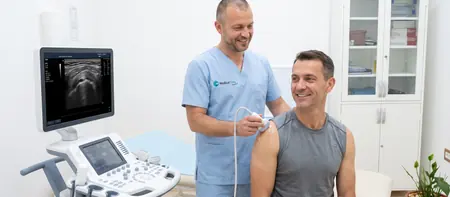
What a shoulder ultrasound examines
The shoulder has the widest range of motion of any joint in the body. It is moved and held in place by four tendons that together form the rotator cuff. These tendons are behind most painful shoulders, and ultrasound shows them clearly because they lie just under the deltoid muscle.
Ultrasound does not reliably show bone, cartilage deep in the joint or the labrum (the cartilage rim of the socket). For these structures the doctor may recommend an MRI.
The doctor examines the rotator cuff tendons: supraspinatus, infraspinatus, subscapularis and teres minor. They also check the long head of the biceps tendon in its groove at the front of the shoulder. The scan covers the subacromial bursa above the tendons and the acromioclavicular joint at the top of the shoulder. Fluid in the joint and around the biceps tendon is visible too.
When a shoulder ultrasound is done
The most common reason is shoulder pain that has lasted for weeks, especially when you lift the arm sideways or overhead. Orthopedists also request it after a fall on an outstretched arm or when the arm feels weak. It also makes sense for pain at the front of the shoulder that spreads down the upper arm. After treatment or surgery, ultrasound is used to check the tendon.
A shoulder ultrasound is recommended for:
- pain when lifting the arm sideways that eases when the arm is fully up or down
- night pain, when you cannot lie on the painful shoulder
- weakness when lifting the arm or turning it outwards
- sudden, severe pain without injury, which may come from a calcific deposit
- a shoulder injury from a fall, sport or lifting a load
Painful shoulder when raising the arm
Pain that appears when you lift the arm sideways, roughly between 60 and 120 degrees, is called a painful arc. At that point the supraspinatus tendon and the bursa get squeezed between the head of the upper arm bone and the acromion, the roof of the shoulder blade. This is called shoulder impingement.
Ultrasound shows impingement while you slowly raise the arm. The doctor sees whether the tendon or bursa catches and how thickened they are.
When shoulder pain does not come from the shoulder
Pain in the left shoulder with chest pressure, shortness of breath or sweating can come from the heart. Do not wait for a scan in that case: call emergency services at 194 right away.
If the pain starts in the neck and spreads to the fingers with tingling, the cause is often the cervical spine. Then the right first step is a neurology consultation.
Preparing for a shoulder ultrasound
No preparation is needed for a shoulder ultrasound. Eat and drink normally and take your usual medication.
Before you come, it helps to:
- wear a top that is easy to take off, or a sleeveless top, as the shoulder must be uncovered
- bring a shoulder X-ray or MRI if you have one
- bring a report from an orthopedist or physiatrist if you have already seen one
- remember which movement causes pain, as the doctor repeats it during the scan
How the shoulder scan works and how long it takes
The scan is usually done sitting on a stool without armrests. The doctor stands or sits beside you and applies gel to the shoulder.
You change the position of your arm during the scan. For the biceps tendon your forearm rests on your thigh, palm up. For the supraspinatus you place your hand behind your back, as if reaching for a back pocket. For the subscapularis you turn the arm outwards with the elbow at your side.
At the end the doctor watches the shoulder while you slowly raise your arm sideways. This dynamic part shows impingement of the tendon and bursa, which a still image cannot show.
A shoulder ultrasound usually takes 15 to 30 minutes. It does not hurt, although a movement that normally hurts may bring on the familiar pain for a few seconds.
What the shoulder ultrasound report shows
The doctor tells you the main findings during the scan, and you receive the written report shortly after. Images are stored digitally, so the tendon can be compared with the previous scan at follow-up.
A common finding is tendinitis or tendinopathy, a thickened tendon with altered structure. A tear can be partial, through part of the tendon's thickness, or full-thickness. For a full-thickness tear the doctor measures the size of the gap.
Calcific deposits are calcium in the tendon, most often in the supraspinatus. In subacromial bursitis the bursa is thickened, often with fluid. The scan also shows fluid around the biceps tendon or the tendon slipping out of its groove.
After the report, the orthopedist suggests next steps: rest, exercises, physiotherapy, medication or an MRI if needed.
Calcific deposits in the shoulder
Calcific tendinitis develops when calcium builds up in a rotator cuff tendon. The deposit can cause no symptoms for a long time and then trigger severe pain, including at night.
Ultrasound shows where the deposit is, how large it is and whether it is hard or softer. The orthopedist chooses treatment based on this.
Shoulder ultrasound or MRI
For the rotator cuff tendons ultrasound is a reliable test. For full-thickness tears its accuracy is close to that of MRI.
Ultrasound is quick, silent and does not involve a closed space. The shoulder is examined in motion and compared with the other shoulder on the spot. It shows calcific deposits more clearly than MRI.
MRI shows the labrum, cartilage, bone and the muscles deep around the joint better. Orthopedists request it for shoulder instability and dislocation and before planned surgery.
That is why a shoulder ultrasound usually comes first, and an MRI follows when a more detailed view inside the joint is needed.
Shoulder ultrasound cost
A shoulder ultrasound costs from 6,000 RSD. Book your appointment by phone at 062-399-888. When you book, tell us whether one or both shoulders need scanning. Prices for other diagnostics are in the price list.
- Shoulder ultrasound
- Soft tissue ultrasound
- Orthopedic consultation
For an appointment call 062-399-888.
Shoulder ultrasound: frequently asked questions
No. Just wear a top that is easy to take off and bring any earlier shoulder images.
Usually 15 to 30 minutes, including the dynamic part in which you slowly raise your arm.
No. The probe only glides over the skin, and brief pain may occur when the doctor asks for a movement that normally hurts.
Yes. Ultrasound shows both partial and full-thickness rotator cuff tears and measures the size of the gap.
Yes, very clearly. Ultrasound shows the position and size of the deposits, often better than MRI.
The most common cause is impingement: the supraspinatus tendon and bursa are squeezed under the roof of the shoulder blade. Ultrasound shows this while you raise the arm.
For tendons, bursitis and calcific deposits ultrasound is the first choice because it is quick and shows the shoulder in motion. For the labrum, cartilage and shoulder instability MRI is better.
A shoulder ultrasound costs from 6,000 RSD. Book your appointment by phone at 062-399-888. When you book, tell us whether one or both shoulders need scanning. Prices for other diagnostics are in the price list.
Related pages
Related exams